How to read your horoscope without overthinking it
A simple, grounded guide to getting something meaningful from your daily horoscope without letting it make your decisions for you.
In this article (10)
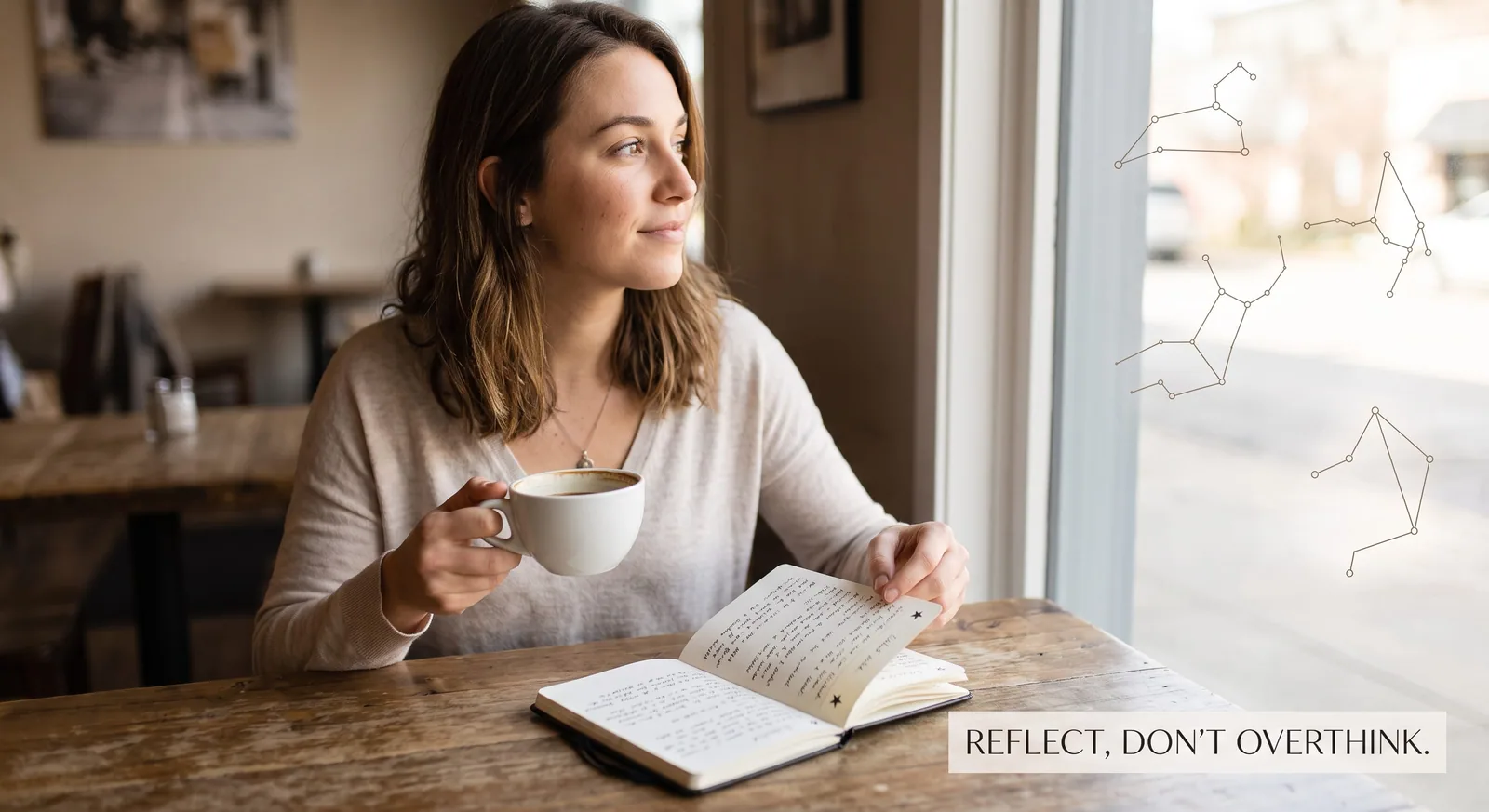
A daily horoscope can be a beautiful little pause in your day.
You read a few lines over your morning coffee. Something catches your attention. Maybe it describes a conversation you have been avoiding, a change you have been considering, or simply a feeling you could not quite put into words.
And then comes the temptation to ask:
Is this really going to happen?
That is usually where reading a horoscope becomes less helpful.
You do not have to treat your horoscope as a prediction of what your day will bring. You can use it as something much gentler: a prompt for reflection.
A good horoscope does not need to tell you what will happen. Sometimes it simply helps you notice what is already happening inside you.
Read your horoscope as a prompt, not a forecast
The most useful way to read a horoscope is to approach it with curiosity rather than certainty.
Instead of asking, “Will this come true today?”, try asking:
- Does this resonate with me right now?
- Is there a situation in my life that this brings to mind?
- Is there something I have been avoiding or overlooking?
- What part of this message feels meaningful to me?
- Is there another way of looking at what I am experiencing?
That small change in perspective can make a big difference.
A horoscope can offer a mirror without claiming to be a map.
You might read that today is a good day to have an honest conversation. Perhaps you immediately think of someone you have been meaning to speak with. The value is not necessarily that the stars have predicted a conversation. The value may simply be that the message helped you recognize something that was already sitting quietly in your mind.
That is often where astrology becomes most useful: not in telling you what to do, but in helping you ask better questions.
Your horoscope is not a script for your day
It is easy to fall into the habit of looking for evidence that a horoscope is coming true.
You read that someone from your past might return, so every unexpected message suddenly feels significant.
You read that there could be tension at work, and suddenly an ordinary disagreement feels like confirmation.
This is where overthinking can take over.
Instead of living your day and occasionally reflecting on your horoscope, you begin trying to make your day fit the horoscope.
That is backwards.
Your life comes first.
Your horoscope should never require you to reinterpret every conversation, coincidence, mood, or inconvenience as a cosmic message.
Read it. Consider it. Keep what feels meaningful. Then go live your day.
Know which astrological sign you are actually reading for
When people talk about their horoscope, they usually mean their Sun sign.
Your Sun sign is the zodiac sign the Sun was in when you were born. It is the sign most commonly used in newspaper and online horoscopes, which is why you may be familiar with descriptions such as Aries, Taurus, Gemini, and so on.
But your Sun sign is not the only important placement in your birth chart.
Your Moon sign describes another layer of your astrological makeup, particularly themes associated with emotions, instincts, comfort, and your inner world.
Your Rising sign, also called your Ascendant, is the zodiac sign that was rising on the eastern horizon at the time and place of your birth. In astrology, it is associated with how you approach life, your outward style, and the way you meet the world.
This can matter when reading daily horoscopes.
Sun sign horoscope
Your Sun sign is the best place to start if you are new to astrology.
It gives you the broadest and most familiar version of a horoscope and can offer useful themes for reflection.
Moon sign horoscope
Your Moon sign may feel more relevant when the horoscope is talking about emotions, relationships, security, intuition, or your inner experience.
If you are particularly interested in how you are feeling rather than what is happening externally, your Moon sign can be worth exploring.
Rising sign horoscope
Your Rising sign can be especially interesting for daily and weekly astrology.
If you regularly read your Sun sign horoscope and find that it rarely feels like it is speaking to your life, try reading your Rising sign horoscope for a week.
Do not immediately decide that one is “more accurate.” Simply notice what happens.
Does the language feel more relevant? Do the themes connect more naturally with what is happening around you?
You may find that your Rising sign gives you a different perspective on the same day.
What if your horoscope doesn't fit?
Sometimes a horoscope will feel incredibly specific.
Other times, it will feel like it was written for someone else entirely.
That is normal.
Not every horoscope will resonate with you every day.
In fact, being skeptical when something does not fit is part of having a healthy relationship with astrology.
You do not need to force a connection.
If your horoscope says you are going to feel restless but you feel completely peaceful, you do not have to search for hidden restlessness.
If it says an important relationship is entering a new phase but nothing feels different, you do not need to create a problem simply to make the horoscope make sense.
Let it miss.
A horoscope that needs you to reverse-engineer your entire day in order to prove it was correct is not particularly useful.
Take what resonates.
Leave what does not.
Come back another day.
Don't confuse coincidence with certainty
One of the easiest ways to overthink astrology is to treat every coincidence as proof.
You read that you may hear from an old friend, and later that afternoon you see their name online.
Interesting? Absolutely.
Proof that the horoscope predicted your afternoon? Not necessarily.
There is something beautiful about synchronicity, and you can enjoy meaningful coincidences without needing to turn them into absolute evidence.
Spirituality does not have to mean certainty.
Sometimes the most grounded approach is to say:
“That was interesting. I wonder why it stood out to me.”
And then leave the question open.
Use your horoscope to check in with yourself
A daily horoscope can become a simple mindfulness practice.
Before reading it, take a moment to notice how you actually feel.
Are you excited about something?
Anxious?
Tired?
Hopeful?
Avoiding a decision?
Thinking about someone?
Then read your horoscope.
Notice what catches your attention.
You might find that the sentence that stays with you is not necessarily the most dramatic one. It may be a small reminder to slow down, speak honestly, protect your energy, or make room for something new.
That can be enough.
You do not need a huge revelation every morning.
Sometimes astrology simply gives you permission to pause.
A simple three-step way to read your daily horoscope
If you tend to overthink your horoscope, try this approach.
1. Read it once
Do not dissect every sentence.
Read the horoscope from beginning to end and notice your first reaction.
What immediately catches your attention?
2. Ask one question
Choose one idea from the reading and turn it into a question.
For example:
“Where in my life am I being asked to slow down?”
Or:
“Is there a conversation I already know I need to have?”
Let the question sit with you.
3. Put the horoscope down
This might be the most important step.
You have read it. You have reflected. Now go live your day.
You do not need to check back every hour to see whether the prediction is happening.
The purpose of a horoscope is not to make you watch your life from the sidelines.
It is to help you become a little more present in it.
How accurate are horoscopes?
There is no need to measure a horoscope's value only by whether it predicts specific events correctly.
Astrology is traditionally used as a symbolic system for interpreting planetary positions and their relationship to human experience. Different astrological traditions approach this in different ways, and astrology is not scientifically established as a reliable method for predicting future events.
That does not mean a horoscope cannot be personally meaningful.
A symbolic reading can give you language for something you are feeling. It can encourage self-reflection. It can help you consider a different perspective.
The important distinction is between reflection and certainty.
A horoscope can inspire a question without providing a guaranteed answer.
You don't have to believe everything to find something meaningful
You can approach astrology with complete belief, gentle curiosity, or healthy skepticism.
You do not have to choose between “everything is written in the stars” and “none of this means anything.”
There is plenty of room in between.
Perhaps you read your horoscope because it gives you a moment of quiet.
Perhaps you enjoy the symbolism.
Perhaps you like seeing your experiences through a different lens.
Or perhaps you are simply curious.
Whatever brings you there, you are allowed to take what helps and leave the rest.
Let the stars be a mirror, not the steering wheel
The healthiest relationship with a horoscope is one where you remain in charge of your own life.
Your horoscope can suggest a question.
It can offer a new perspective.
It can give you a moment to pause and listen to yourself.
But it should not make your decisions for you.
If a horoscope tells you to walk away from someone you love, you do not have to do it because the stars said so.
If it tells you today is unlucky, you do not have to spend the day afraid.
If it suggests an opportunity, you can consider it without assuming the universe has guaranteed the outcome.
Let astrology open a door to reflection. You decide whether to walk through it.
And sometimes, that is the most useful horoscope of all.
Frequently asked questions
Should I read my Sun sign or Rising sign horoscope?
What is the difference between a Sun sign and a Rising sign?
Should I read my Moon sign horoscope too?
What should I do if my horoscope doesn't match my day?
Are horoscopes supposed to predict the future?
How can I stop overthinking my horoscope?
Can a horoscope help with self-reflection?
Is it okay to ignore a horoscope?
Keep reading

Across Psychic Pulse
The same themes, seen through another practice.