
Decoding Karmic Debt Numbers (13, 14, 16, 19): What Your Chart Reveals About Core Life Lessons
Discover what karmic debt numbers 13, 14, 16 and 19 mean in numerology, where they appear in your chart, and the spiritual lessons each number reveals.
In this article (13)
There are numbers in a numerology chart that feel less like personality traits and more like recurring themes.
You work hard, but somehow keep finding yourself tested around discipline. You crave freedom, yet excess or restlessness keeps pulling you off course. You build something you believe in, only to experience a profound reset that forces you to question your identity. Or you insist on doing everything alone until life teaches you that independence and receiving support are not opposites.
In numerology, these patterns can sometimes be associated with karmic debt numbers.
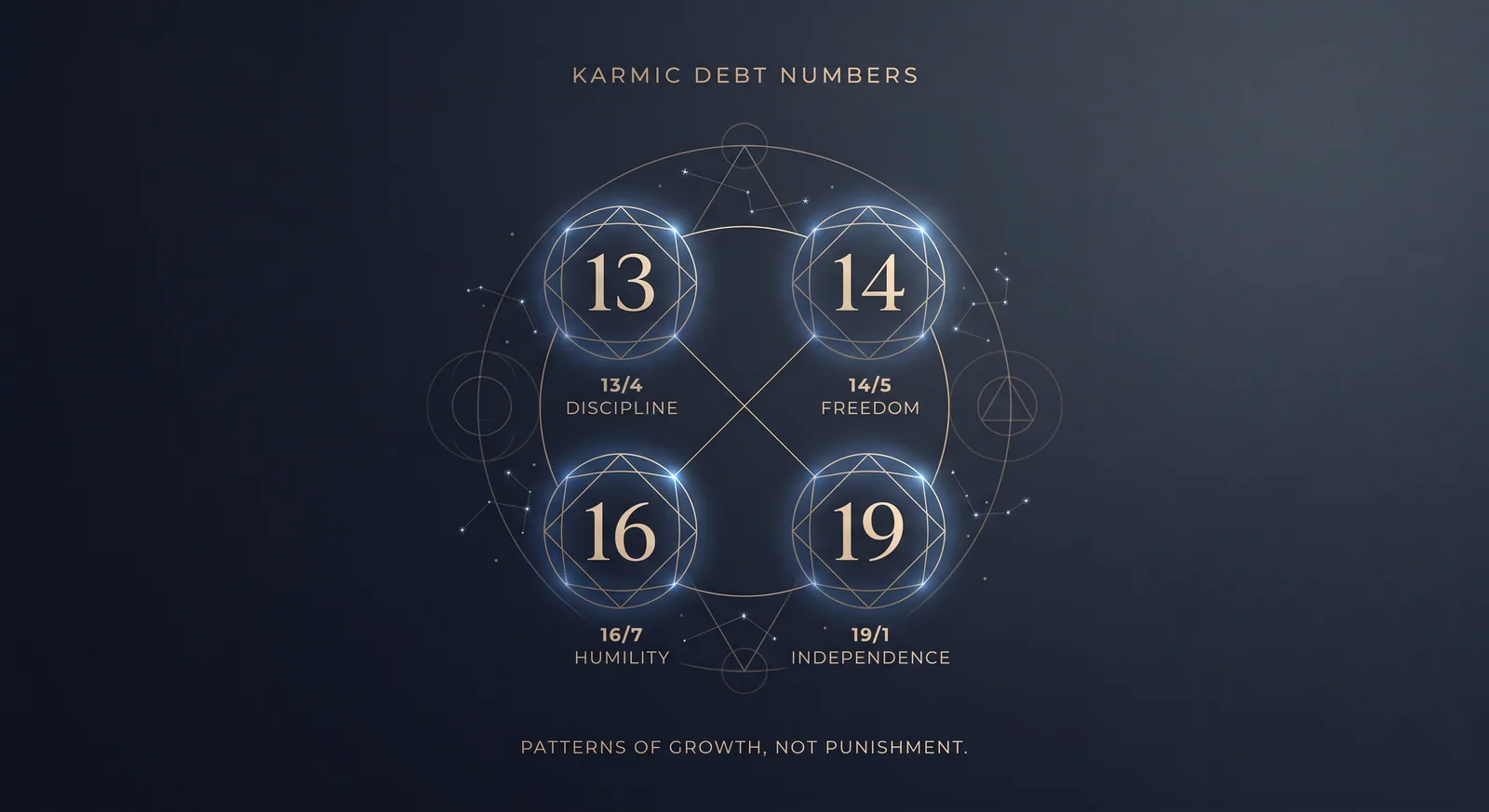
The four numbers traditionally identified as karmic debt numbers are 13, 14, 16, and 19. They are often written as 13/4, 14/5, 16/7, and 19/1, because each two-digit number reduces to a single digit. The compound number describes the deeper lesson, while the reduced number describes the energy through which that lesson is expressed.
But "karmic debt" doesn't have to mean punishment.
A more useful spiritual interpretation is unfinished learning: a recurring area of life where consciousness is being asked to mature.
Karmic debt is not a sentence. It is a pattern asking to become conscious.
Let's explore what each number means, where you might find it in your chart, and how to work with its lesson.
What Are Karmic Debt Numbers in Numerology?
In numerology, numbers are generally reduced to a single digit.
For example:
- 13 becomes 1 + 3 = 4
- 14 becomes 1 + 4 = 5
- 16 becomes 1 + 6 = 7
- 19 becomes 1 + 9 = 10 → 1 + 0 = 1
Normally, you might simply interpret the final number.
But in numerology traditions that use karmic debt, the compound number matters too. If a calculation reaches 13 before becoming 4, it can be read as 13/4, rather than simply 4. The same principle applies to 14/5, 16/7 and 19/1.
This creates an important distinction:
Two people can share the same final number while having different paths to that number.
For example, both might have a 7, but one could be a straightforward 7 while another is specifically 16/7. In the traditional interpretation, the latter carries an additional theme around ego, humility, surrender, and inner transformation.
The karmic number doesn't replace the final number.
It adds another layer to it.
Are Karmic Debt Numbers Bad?
No.
This is one of the most important misconceptions to clear up.
The word debt can sound frightening, as though having 13, 14, 16, or 19 in your chart means you are destined to suffer.
That's not the most constructive way to read these numbers.
Numerology is a symbolic and spiritual system, not a scientifically validated method for predicting events. Within the tradition itself, karmic debt is better understood as an area where a person may repeatedly encounter opportunities to develop greater awareness, balance, or maturity.
In other words, your karmic number isn't saying:
"Something bad will happen to you."
It's asking:
"What pattern keeps asking you to grow?"
That distinction changes everything.
Where Do Karmic Debt Numbers Appear in a Numerology Chart?
Karmic debt numbers can appear in several parts of a numerology chart, depending on the numerology system being used.
Common placements include:
Life Path Number
The Life Path describes the broad developmental direction of your life.
If your birth-date calculation produces 13, 14, 16, or 19 before reduction, the karmic theme is considered particularly significant because it is attached to your overall life path.
For example:
13 → 4
would be interpreted as a 13/4 Life Path.
The 4 describes the foundational energy of discipline, structure, and practical achievement.
The 13 adds the lesson: learn to build through consistent effort rather than shortcuts.
Expression or Destiny Number
The Expression Number, sometimes called the Destiny Number, is calculated from the letters of your full birth name.
It describes themes around how you express your abilities, talents, and potential in the world.
If your name calculation produces 14 before reducing to 5, for example, you could read this as 14/5.
Here, the lesson of freedom and moderation may show up particularly strongly through career, communication, relationships and personal expression.
Birthday Number
Your day of birth can also be significant.
If you were born on the:
- 13th → 13/4
- 14th → 14/5
- 16th → 16/7
- 19th → 19/1
some numerology traditions treat that number itself as a karmic debt indicator.
This placement can feel more personal and immediate because it is connected directly to your birth day.
Soul Urge and Other Core Numbers
Some numerology systems also examine the Soul Urge, Personality, and other core chart positions for these compound numbers.
The exact rules vary between numerology schools, so when calculating karmic debt, it's important to know which methodology you're using.
The key principle is simple:
Don't look only at the final single digit. Look at the number that came before it.
The Four Karmic Debt Numbers
Each karmic debt number carries a different spiritual lesson.
| Karmic Number | Reduced Number | Core Lesson |
|---|---|---|
| 13/4 | 4 | Discipline, effort, and building without shortcuts |
| 14/5 | 5 | Freedom, moderation and responsible choice |
| 16/7 | 7 | Humility, ego dissolution and authentic self-worth |
| 19/1 | 1 | Independence, self-reliance and learning to receive |
Now let's look at each one more deeply.
13/4 Karmic Debt: The Lesson of Discipline
13/4 is often associated with work, discipline, structure, and the temptation to look for the easiest route.
The traditional interpretation connects 13 with patterns of avoiding necessary effort or relying on shortcuts. Its lesson is to discover what becomes possible when you commit to the process rather than constantly searching for a faster way.
The shadow of 13/4
You might recognize patterns such as:
- Starting projects but struggling to finish them
- Wanting results before the foundation is ready
- Becoming frustrated with slow progress
- Resisting routine
- Looking for shortcuts
- Repeating cycles of rebuilding
- Feeling that everyone else seems to advance more easily
The deeper lesson isn't simply "work harder."
It's:
Learn to respect the process.
The 13/4 soul lesson asks you to understand that repetition isn't necessarily punishment. Sometimes repetition is how mastery is created.
The gift of 13/4
When integrated, 13/4 can become remarkably grounded.
You learn how to:
- Create systems
- Follow through
- Build patiently
- Turn ideas into tangible results
- Develop practical mastery
- Trust incremental progress
The person who once wanted to skip the difficult part can eventually become someone who understands how things are actually built.
Spiritual question for 13/4
Where am I trying to skip a step that life is asking me to master?
14/5 Karmic Debt: The Lesson of Freedom
14/5 revolves around one of humanity's most complicated desires:
freedom.
The number 5 is associated with movement, experience, change, curiosity, and independence. But when it appears as 14/5, numerology traditionally places additional emphasis on moderation and responsible use of freedom.
The lesson isn't to give up freedom.
It's to learn how to hold freedom without being controlled by it.
The shadow of 14/5
This can manifest as:
- Restlessness
- Impulsiveness
- Difficulty with commitment
- Excess
- Constantly seeking the next experience
- Escaping uncomfortable emotions
- Wanting freedom without responsibility
- Difficulty maintaining boundaries
Sometimes 14/5 creates a fascinating paradox.
The person desperately wants freedom, but the choices made in pursuit of freedom eventually create less freedom.
Too much impulsiveness creates consequences.
Too much avoidance creates unfinished business.
Too much stimulation makes stillness uncomfortable.
The gift of 14/5
The mature 14/5 learns that structure and freedom don't have to be enemies.
Healthy routines can create freedom.
Boundaries can create freedom.
Financial discipline can create freedom.
Emotional responsibility can create freedom.
The spiritual lesson becomes:
Choose your freedom rather than constantly chasing it.
When integrated, 14/5 can become adaptable, adventurous, charismatic, and remarkably resilient.
Spiritual question for 14/5
Am I using freedom to create my life—or using freedom to avoid my life?
16/7 Karmic Debt: The Lesson of Humility
Of the four karmic debt numbers, 16/7 is often described as the most transformative.
It is associated with ego, identity, attachment, and the collapse of structures that were built on an unstable foundation. Traditional numerology interprets 16 as a lesson in humility and spiritual awakening.
This doesn't mean that everyone with 16/7 is destined for dramatic loss.
The deeper symbolism is about what happens when the identity we have built can no longer carry the person we are becoming.
The shadow of 16/7
The pattern can involve:
- Excessive pride
- Defining self-worth through achievement
- Difficulty admitting vulnerability
- Attachment to being right
- Controlling how others perceive you
- Sudden changes that challenge your identity
- Feeling disconnected from your deeper self
Sometimes life seems to remove something that you thought defined you.
A career.
A relationship.
A status.
A belief about yourself.
A carefully constructed identity.
And beneath the loss comes an uncomfortable question:
Who am I without this?
The gift of 16/7
This is where 16/7 becomes profoundly spiritual.
The lesson isn't humiliation.
It's liberation from a false identity.
The mature 16/7 can develop:
- Deep introspection
- Spiritual humility
- Authentic self-worth
- Intuition
- Emotional depth
- Detachment from external validation
- A stronger connection to inner truth
The ego doesn't disappear.
It simply stops being the only voice in the room.
Spiritual question for 16/7
If I stopped needing to prove who I am, what would remain?
19/1 Karmic Debt: The Lesson of Independence
19/1 carries the energy of independence, leadership, and self-reliance.
The 1 wants to stand on its own feet.
That is its strength.
But the karmic lesson traditionally associated with 19 is learning the difference between healthy independence and isolation.
The shadow of 19/1
You may recognize patterns such as:
- "I'll do it myself."
- Difficulty asking for help
- Feeling uncomfortable depending on others
- Taking responsibility for everything
- Struggling to receive
- Becoming overly self-protective
- Confusing vulnerability with weakness
The irony of 19/1 is that someone can become extremely capable while simultaneously making life harder than it needs to be.
They know how to give.
They know how to lead.
They know how to survive.
But they may not know how to receive.
The gift of 19/1
The evolved 19/1 doesn't surrender independence.
It expands the definition of independence.
You can be independent and still ask for help.
You can be powerful and still be vulnerable.
You can lead and still collaborate.
You can stand alone without believing you must stand alone all the time.
The lesson becomes:
True strength includes the ability to receive support.
Spiritual question for 19/1
Where have I confused needing no one with being truly free?
Karmic Debt Numbers vs. Karmic Lessons
These two concepts are sometimes confused.
They're not necessarily the same thing.
A karmic debt number refers specifically to the traditional numbers 13, 14, 16, and 19 and the themes associated with them.
A karmic lesson can refer more broadly to areas of development identified through a numerology chart.
For example, some numerology systems look at numbers that are absent from a person's name chart and interpret those absences as areas where particular qualities need to be developed.
So:
Karmic debt ≠ every karmic lesson.
If you're reading a numerology chart, keep those concepts separate.
How to Find Your Karmic Debt Number
You don't need to have a karmic debt number in order to have a meaningful spiritual path.
But if you want to explore whether one appears in your chart, start with your core numerology calculations.
Step 1: Calculate your Life Path
Use your complete birth date.
Add the digits according to the numerology method you're following.
Pay attention to the compound total before final reduction.
If that total is:
- 13 → 13/4
- 14 → 14/5
- 16 → 16/7
- 19 → 19/1
You have a karmic debt association in that calculation.
Step 2: Check your Birthday Number
Were you born on the 13th, 14th, 16th, or 19th?
If so, some numerology traditions interpret that as a karmic debt Birthday Number.
Step 3: Calculate your Expression Number
Use your full birth name according to the numerology system you're following.
Again, look at the compound number before reduction.
Step 4: Look at the whole chart
A single karmic debt number can tell you something.
Multiple placements can make the theme more prominent.
But don't interpret a chart by isolating one number.
The meaning comes from the relationship between the numbers.
What If You Have More Than One Karmic Debt Number?
It's possible for different positions in a numerology chart to carry different karmic debt numbers.
For example, someone might have:
13/4 Life Path + 19/1 Expression
That doesn't mean they have "double the punishment."
It suggests two distinct themes may be worth exploring:
13/4: learning disciplined, sustainable effort.
19/1: learning healthy independence and receptivity.
The interesting question becomes how these lessons interact.
Perhaps the person has learned to become extremely self-sufficient through relentless effort—but their deeper growth now involves learning when they don't have to do everything alone.
That's where numerology becomes more useful than simply labeling numbers as "good" or "bad."
The chart becomes a map of patterns.
How to Work With Karmic Debt Numbers
The healthiest approach isn't fear.
It's awareness.
If you discover a karmic debt number, try asking yourself:
For 13/4:
Where am I avoiding the process because I want the result?
For 14/5:
Where does my desire for freedom become self-sabotage?
For 16/7:
What part of my identity am I being asked to release?
For 19/1:
Where would receiving support actually make me stronger?
You don't "pay off" a karmic number by performing a ritual or suffering through difficult experiences.
Instead, the spiritual work is to become conscious of the pattern.
The goal isn't punishment.
The goal is integration.
The Deeper Meaning of Karmic Debt
Perhaps the most beautiful way to understand karmic debt is to stop thinking about the word debt entirely.
Think of these numbers as unfinished conversations with yourself.
13/4 asks:
"Can you learn to build?"
14/5 asks:
"Can you be free without becoming scattered?"
16/7 asks:
"Can you know your worth without needing to prove it?"
19/1 asks:
"Can you be independent without closing yourself off from others?"
Each number points toward balance.
And that is ultimately what makes karmic numerology so compelling.
The number isn't predicting your destiny.
It's inviting you to participate in it.
Karmic Debt Numbers: Quick Reference
| Number | Reduced To | Core Challenge | Higher Expression |
|---|---|---|---|
| 13/4 | 4 | Shortcuts, inconsistency, resistance to discipline | Mastery through sustained effort |
| 14/5 | 5 | Excess, restlessness, misuse of freedom | Freedom with moderation |
| 16/7 | 7 | Ego, attachment, external validation | Humility and authentic self-worth |
| 19/1 | 1 | Isolation, excessive self-reliance | Independent strength with receptivity |
Final Takeaway: Your Karmic Number Is a Teacher, Not a Punishment
If you discover 13, 14, 16, or 19 in your numerology chart, don't panic.
You haven't been handed a cosmic punishment.
You've been given another lens through which to understand yourself.
13/4 teaches disciplined creation.
14/5 teaches conscious freedom.
16/7 teaches humility and inner truth.
19/1 teaches independent strength without isolation.
The most powerful question isn't:
"What bad karma do I have?"
It's:
"What is this pattern trying to teach me?"
Because once a pattern becomes conscious, it no longer has to control the story.
It can become the place where your greatest growth begins.
Life path number calculator
Enter your birth date and see your life path number, master numbers included, with every step shown.
Frequently asked questions
What are the four karmic debt numbers?
What does 13/4 karmic debt mean?
What does 14/5 karmic debt mean?
What does 16/7 karmic debt mean?
What does 19/1 karmic debt mean?
Is karmic debt number 13 bad?
How do I know if I have a karmic debt number?
Can I have more than one karmic debt number?
What is the difference between karmic debt and karmic lessons?
Keep reading


Across Psychic Pulse
The same themes, seen through another practice.