Synastry vs Composite Charts: What Your Relationship Is Trying to Teach You
Why can two people feel an undeniable connection yet struggle to build a life together? Synastry and composite astrology offer two different perspectives on the same relationship: one focused on the connection between two souls, the other on the energy created between them.
In this article (10)
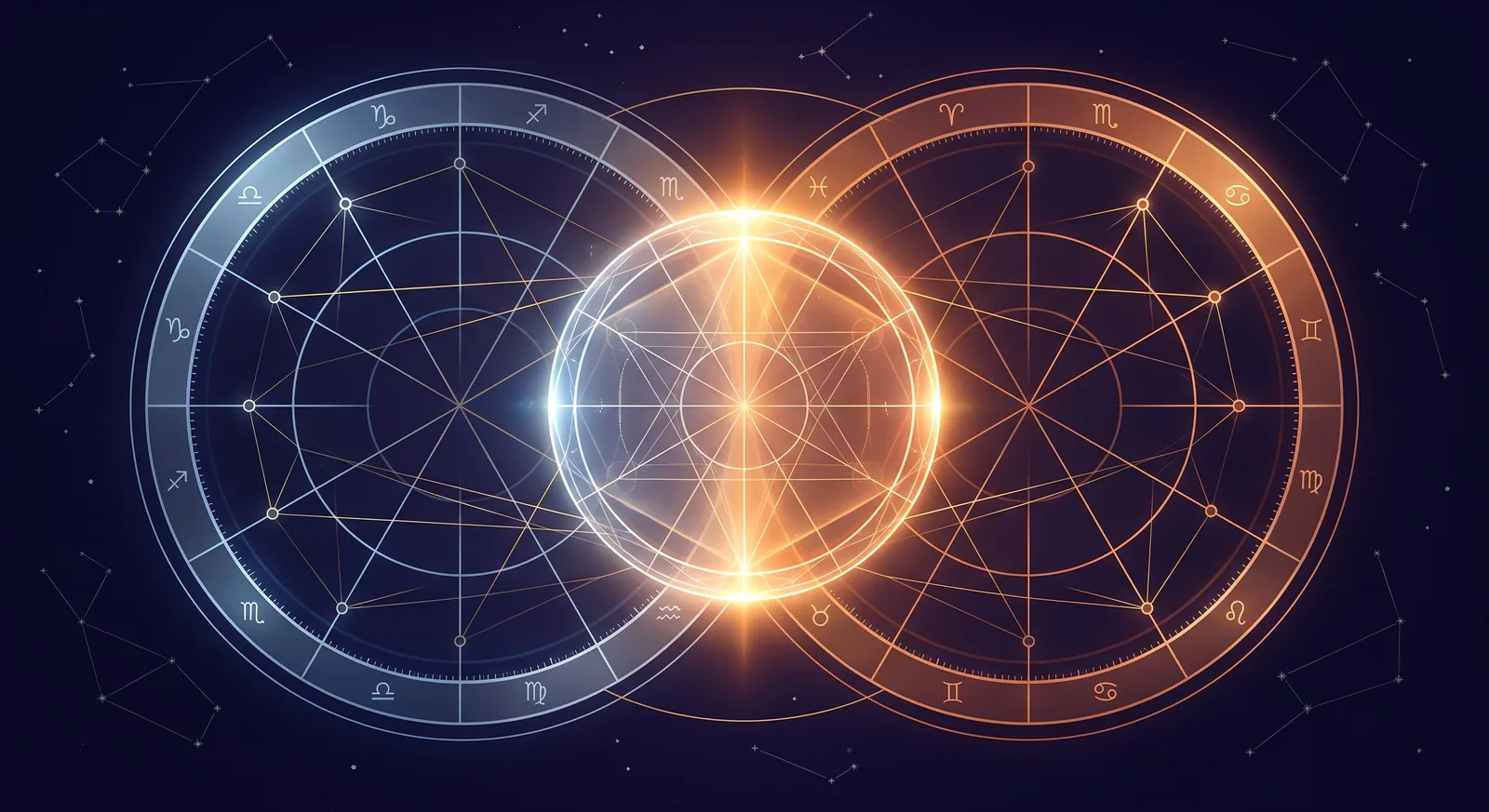
Synastry explores the way two people awaken something in each other. A composite chart explores the energy created when those two lives come together.
There are relationships that feel electric from the moment you meet.
You may feel strangely familiar with someone. Conversation flows effortlessly. There is attraction, emotional intensity, or the feeling that meeting this person somehow mattered.
And then there are relationships that don't begin with fireworks at all.
Instead, something slowly unfolds. Trust grows. Life becomes more intertwined. You begin to discover that the relationship itself has a personality, rhythm, and purpose of its own.
This is where relationship astrology becomes especially interesting.
When astrologers explore the connection between two people, they often use two different approaches: synastry and the composite chart.
They are related, but they are not the same.
Synastry looks at how two people affect each other.
A composite chart looks at what is created when those two people come together.
One explores the meeting of two individual energies. The other explores the relationship as its own living experience.
Understanding both can offer a much deeper perspective on love, attraction, emotional patterns, and the spiritual lessons relationships can bring.
What Is Synastry in Astrology?
Synastry is a form of relationship astrology that compares two people's birth charts to explore how their energies interact.
Rather than asking whether two people are simply "compatible," synastry asks more meaningful questions:
- What draws these two people toward each other?
- What makes the connection feel emotionally powerful?
- Why does one person bring out certain qualities in the other?
- Where might misunderstandings or emotional triggers arise?
- What does each person awaken in the other?
Think of synastry as the conversation between two souls.
Your planets remain yours. Their planets remain theirs. But when the two charts meet, certain parts of each person become more noticeable.
Someone may make you feel seen.
Someone else may challenge you.
Another person may awaken your confidence, sensuality, vulnerability, creativity, or desire for emotional intimacy.
This is why a synastry connection can feel powerful even when the relationship itself is complicated.
Synastry Is About the Connection Between You
Synastry can help illuminate the experience of being with someone.
For example, strong Venus and Mars connections are traditionally associated with attraction and romantic chemistry. Moon connections can highlight emotional resonance, while Saturn connections can bring themes of responsibility, commitment, maturity, or lessons around boundaries.
But no single aspect determines the fate of a relationship.
Astrology is better understood as a language for reflection than a guarantee of what will happen.
A challenging connection isn't automatically bad.
Sometimes the relationships that challenge us the most are the ones that encourage the deepest personal growth.
What Is a Composite Chart?
A composite chart takes a different approach.
Instead of primarily asking how one person's planets interact with another person's planets, composite astrology creates a symbolic chart representing the relationship itself.
It is often described as the birth chart of the relationship.
The idea is beautifully simple:
Two people come together, and something new exists between them.
That "something" might be a romantic partnership, marriage, friendship, business partnership, or another significant relationship.
The composite chart explores the energetic atmosphere of that shared experience.
It can raise questions such as:
- What does this relationship feel like when we are together?
- What is the deeper purpose of this connection?
- What themes emerge when our lives become intertwined?
- How does the relationship express itself to the outside world?
- What does this partnership invite us to learn or experience?
Rather than focusing only on you and me, composite astrology asks:
What happens when there is an "us"?
Synastry and Composite Charts Tell Different Stories
A simple way to understand the difference is this:
Synastry: How do we affect each other?
Composite: What do we create together?
Imagine meeting someone and immediately feeling an extraordinary attraction.
That experience belongs largely to the territory of synastry.
But months or years later, you may discover that the relationship has developed its own emotional patterns, priorities, challenges, and sense of purpose.
That is where the composite perspective can become meaningful.
The two approaches are not competing interpretations.
They are two lenses looking at the same relationship.
Why Strong Chemistry Doesn't Always Become a Lasting Relationship
One of the most important lessons relationship astrology can offer is that chemistry and compatibility are not necessarily the same thing.
You can feel deeply attracted to someone without being ready to build the same kind of life.
You can have extraordinary emotional chemistry while wanting completely different things.
You can meet someone who awakens parts of yourself you didn't know existed—and still discover that the relationship cannot continue in its current form.
This doesn't mean the relationship was a mistake.
Sometimes a relationship's purpose is not permanence.
Sometimes it is awakening.
Sometimes it is healing.
Sometimes it teaches you what you need.
And sometimes it becomes a foundation for a shared life.
Astrology can help you reflect on these possibilities without turning them into fixed predictions.
When Synastry Feels Powerful but the Relationship Feels Difficult
Imagine two people who experience tremendous attraction.
There may be strong Venus-Mars connections, emotional intensity, and a sense of magnetic familiarity.
Yet once they begin sharing everyday life, other realities appear.
Their communication styles may clash.
Their emotional needs may differ.
Their priorities may not align.
The relationship may feel incredible when they are together but difficult when dealing with money, family, responsibilities, or long-term decisions.
This is an important distinction.
A powerful connection does not automatically mean an easy relationship.
Synastry can help illuminate why two people are so strongly drawn to each other, while the composite perspective can invite reflection on what happens once the relationship becomes a shared reality.
When Challenging Synastry Creates Meaningful Growth
The opposite can also happen.
Two people may have plenty of tension in their synastry.
They may communicate differently.
They may challenge each other's emotional habits.
They may trigger fears or insecurities that neither expected to encounter.
Yet the relationship may become one of the most transformative experiences of their lives.
Why?
Because relationships aren't designed only to make us comfortable.
Some relationships reveal where we need to grow.
They teach patience.
They teach boundaries.
They teach communication.
They teach vulnerability.
They teach us how to love without losing ourselves.
This is why difficult astrological aspects shouldn't automatically be interpreted as signs of an unhealthy or doomed relationship.
The question isn't simply:
"Is this relationship easy?"
A more meaningful question is:
"What is this relationship inviting me to become?"
The Most Important Synastry Themes
You don't need to memorize dozens of astrological aspects to begin exploring relationship astrology.
A few themes can provide a useful starting point.
Venus and Mars: Attraction and Desire
Venus is traditionally associated with affection, beauty, pleasure, and the way we give and receive love.
Mars relates to desire, action, passion, and how we pursue what we want.
When Venus and Mars interact strongly between two charts, astrologers often look for themes of attraction and romantic chemistry.
But attraction is only one layer of a relationship.
It tells you about the spark—not necessarily the entire journey.
Moon Connections: Emotional Recognition
The Moon speaks to emotional needs, comfort, vulnerability, and instinctive reactions.
Strong Moon connections between two people can create a feeling of emotional familiarity.
You may feel that someone understands you without needing many words.
But the Moon can also reveal emotional triggers.
Someone who makes you feel deeply understood may also touch places within you that need healing.
Saturn: Commitment, Responsibility, and Growth
Saturn is sometimes feared in relationship astrology because its energy can feel serious.
But Saturn isn't simply about limitation.
It can also represent patience, maturity, responsibility, and the willingness to build something slowly.
In a relationship, Saturn can ask:
Are we willing to do the work?
That question can be uncomfortable, but meaningful.
The Most Important Composite Chart Themes
Composite astrology shifts the focus toward the relationship as a whole.
The Composite Sun: The Heart of the Relationship
The Sun can symbolize the central identity and vitality of the relationship.
It invites reflection on questions such as:
What gives this relationship its sense of purpose?
What does this relationship want to express?
The Composite Moon: The Emotional Atmosphere
The Moon can describe the emotional tone of the relationship.
Does the connection feel nurturing?
Private?
Restless?
Protective?
Emotionally demanding?
The composite Moon can help describe the atmosphere that develops when the two people are together.
The Seventh House: Partnership
The seventh house has long been associated with committed partnerships and one-to-one relationships.
In a composite chart, it can offer another perspective on how the relationship approaches commitment, cooperation, and partnership.
Saturn: The Structure of the Bond
Composite Saturn can symbolize the responsibilities and commitments that give a relationship structure.
Sometimes that structure feels heavy.
Sometimes it provides exactly the stability the relationship needs.
The deeper lesson is that lasting relationships usually require more than attraction.
They require presence.
Communication.
Responsibility.
Choice.
And a willingness to keep growing.
Which Is More Important: Synastry or Composite?
This is one of the most common questions in relationship astrology.
The answer is: neither is more important.
They answer different questions.
Synastry explores the interaction between two individuals.
Composite astrology explores the relationship created between them.
If you want to understand why you feel drawn to someone, synastry can offer valuable insight.
If you want to understand what the relationship feels like as a shared experience, the composite chart offers another perspective.
For a deeper relationship reading, both can be considered alongside the individual birth charts.
Can a Difficult Composite Chart Still Represent a Good Relationship?
Absolutely.
Astrology doesn't replace free will, communication, emotional maturity, or real-world circumstances.
A challenging composite chart doesn't mean a relationship is destined to fail.
Likewise, harmonious astrology doesn't guarantee a happy partnership.
Two people still have choices.
They can communicate or avoid difficult conversations.
They can respect boundaries or ignore them.
They can grow together or grow apart.
Astrology can describe patterns and possibilities.
It does not make the decisions for you.
When Does a Composite Chart "Take Effect"?
There isn't a universally agreed moment when a composite chart suddenly becomes active.
Rather than thinking of the composite as something that switches on at a particular milestone, it can be more helpful to think of it as a symbolic representation of the relationship's shared energy.
As two people become more emotionally and practically intertwined, the themes represented by the composite chart may become easier to recognize.
Moving in together, becoming committed, building a family, sharing finances, or simply creating a deep emotional bond can all make the relationship's shared identity more visible.
Synastry vs Composite: The Deeper Meaning
Ultimately, the difference between synastry and composite astrology is more poetic than technical.
Synastry is the meeting.
The composite is what emerges from the meeting.
Synastry can show why someone's presence touches you so deeply.
Composite astrology can help you reflect on what the two of you create when you are together.
One looks at the individual experience of connection.
The other looks at the shared experience of relationship.
And perhaps the most important lesson is that neither needs to tell you whether someone is "the one."
Instead, astrology can encourage a more meaningful question:
What is this relationship revealing about me, about love, and about the person I am becoming?
Because sometimes the most important relationships aren't simply the ones that stay.
They are the ones that change us.
Frequently asked questions
What is the difference between synastry and a composite chart?
Is synastry or a composite chart better for relationship compatibility?
Does good synastry mean a relationship will last?
What does Venus-Mars synastry mean?
What does Saturn mean in relationship astrology?
Can difficult synastry still indicate love?
Can a composite chart predict whether a relationship will last?
Do you need both synastry and composite charts?
Keep reading



Across Psychic Pulse
The same themes, seen through another practice.