Reading Tarot Without the Guidebook: How to Trust Your Intuition
Learn how to read tarot intuitively by listening to the story in the cards, noticing their symbols, and allowing your own inner wisdom to guide the reading.
In this article (11)
You turn over a tarot card.
You recognize the image, but suddenly your mind goes blank.
What does this card mean again? Is it about money? Love? Loss? Change?
So you reach for the guidebook.
There is nothing wrong with using traditional tarot meanings. They can be incredibly helpful, especially when you're learning. But if you always look up the answer before allowing yourself to connect with the card, you may miss something even more important: your own intuitive response.
Learning how to read tarot without the guidebook isn't about abandoning everything you've learned. It's about discovering what happens when you become quiet enough to hear what the cards are saying to you.
Tarot is not simply a system of definitions.
It is a language of images, archetypes, emotions, symbols, and stories.
And sometimes, the first message arrives before you can put it into words.
Why You Don't Need to Memorize Every Tarot Meaning
There are 78 cards in a traditional tarot deck. Each card has layers of symbolism, traditional associations, and countless possible interpretations.
Trying to memorize every meaning can make tarot feel more like studying for an exam than entering a spiritual practice.
You pull the Five of Pentacles and immediately think:
“Five of Pentacles means hardship.”
But what if the image makes you think about loneliness?
What if you notice the warmth inside the window before you notice the people outside?
What if you suddenly think about someone in your life who needs help?
Those impressions aren't necessarily mistakes.
They may be the beginning of your reading.
Traditional tarot meanings give you a foundation. Intuition allows you to discover how that foundation applies to the question, person, and moment in front of you.
The goal isn't to choose between traditional tarot and intuition.
The goal is to let them speak to each other.
How to Read Tarot Without the Guidebook
When you turn over a card, resist the temptation to immediately ask, “What does this card mean?”
Instead, ask:
“What am I noticing?”
That small change can completely transform your tarot practice.
Look at the card as if you've never seen it before.
Notice the people.
Notice their expressions.
Notice where they are looking.
Notice the landscape.
Notice the weather.
Notice what feels bright and what feels hidden.
Then notice what happens inside you.
Does the image feel comforting?
Does it make you uncomfortable?
Does one tiny detail immediately capture your attention?
Does a memory, person, place, or emotion suddenly come to mind?
These impressions can become part of the reading.
Start With the Image
Before reaching for a guidebook, spend a moment simply looking.
Imagine that the card is a scene from a dream.
What is happening?
Who has power in the scene?
Who is waiting?
Who is leaving?
Who is reaching?
Who is hiding?
Who is celebrating?
Who appears lost?
You don't need to know the official meaning of the card to answer those questions.
You are simply observing the story.
And the story often reveals more than you expect.
Pay Attention to What Draws Your Eye
Tarot illustrations contain many details, but you will rarely notice all of them equally.
Perhaps you immediately notice a bird.
Or a doorway.
Or a river.
Or someone's hands.
Or the expression on a person's face.
Don't dismiss that first moment of attention.
Ask yourself:
“Why did I notice that?”
You don't have to force an answer.
Sometimes the significance becomes clear later.
This is one of the simplest ways to develop intuitive tarot reading skills: learn to recognize what your attention naturally moves toward.
Let Color Speak to You
Color can carry emotional and spiritual associations.
You might experience gold as warmth, illumination, confidence, or divine guidance.
Blue might feel peaceful, emotional, mysterious, or deeply intuitive.
Red might suggest passion, vitality, anger, desire, or courage.
Green might evoke healing, nature, growth, or the heart.
But there is no requirement that a particular color mean only one thing.
Your own associations matter.
If blue reminds you of someone you love, that personal connection may be meaningful in a reading.
If a particular shade suddenly makes you think of the ocean, ask yourself why.
Tarot symbolism becomes more powerful when you allow it to connect with your own symbolic language.
Notice the Direction of the Figures
One of the easiest ways to begin reading tarot visually is to watch where the figures are looking and moving.
Is someone walking toward something?
Are they walking away?
Is one person looking directly at another?
Is someone facing the past while another figure looks toward the future?
Do two cards seem to tell one continuous story?
Imagine placing two cards next to each other.
Perhaps a figure in one card is looking directly toward a figure in the next.
That can create a visual conversation.
Maybe one person appears to be moving toward the other.
Maybe they seem to be avoiding each other.
The cards don't have to be interpreted as isolated objects.
Let them interact.
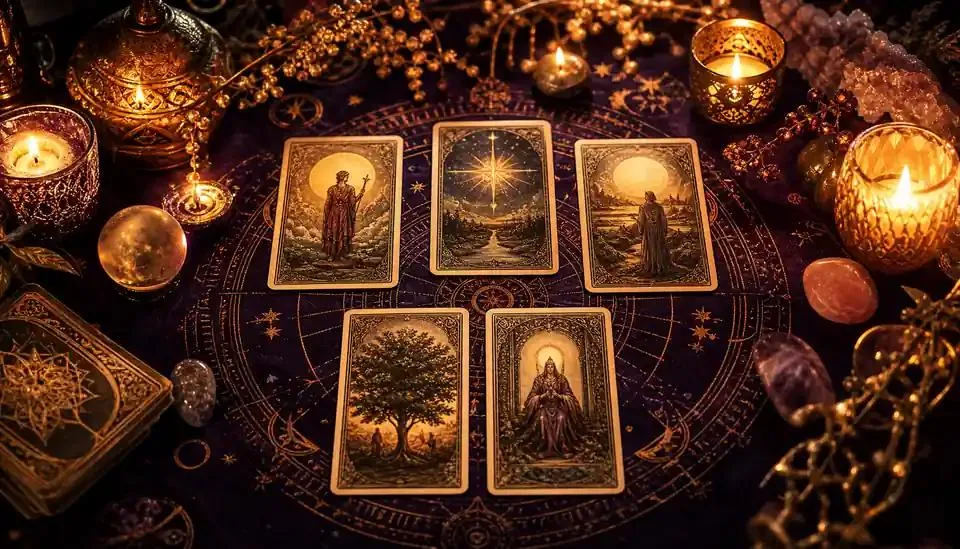
A tarot spread is a story.
Sometimes the meaning lives in the relationship between the cards.
Listen to Your First Feeling
Intuition often arrives quietly.
You may feel drawn toward an image before you know why.
You may experience a sudden sense of relief.
You may feel resistance.
You may become curious.
You may think of someone unexpectedly.
You may even have the feeling, “I don't like this card.”
Don't immediately push that reaction away.
Instead, become curious about it.
Ask:
“What is this card awakening in me?”
That question is often more revealing than “What does this card traditionally mean?”
Your intuitive response doesn't have to be dramatic.
It can be as simple as:
This feels like waiting.
This feels like coming home.
This feels like something I already know.
This feels like a warning.
This feels like freedom.
Those simple impressions can become the heart of your reading.
Your Body Can Help You Listen
Intuition isn't always experienced as a thought.
Sometimes you feel it.
A card may make you take a deeper breath.
Your shoulders might relax.
You might feel a flutter of excitement.
You might suddenly become still.
Another card might create a sense of heaviness or resistance.
Rather than treating these sensations as absolute predictions, treat them as information to explore.
Take a slow breath when you turn over a card.
Pause.
Notice your first response.
Then ask:
“What is this feeling trying to show me?”
This is a gentle form of somatic intuition tarot: using your felt experience as another doorway into the symbolism of the cards.
Your body isn't necessarily giving you a literal yes-or-no answer.
It may simply be telling you where your attention needs to go.
A Simple Tarot Practice for Beginners
If you want to learn how to read tarot without the guidebook, try this exercise once a day.
Choose one card.
Don't look up its meaning.
Instead, move through these three steps.
Step 1: Look
Spend about a minute with the image.
Notice everything you can.
What is happening?
What feels important?
What catches your attention first?
Step 2: Feel
Close your eyes for a moment.
Take a slow breath.
Notice your emotional and physical response to the card.
Do you feel open or closed?
Calm or restless?
Curious or resistant?
You don't need to interpret the feeling yet.
Just notice it.
Step 3: Tell the Story
Describe the card in your own words.
Don't use tarot terminology.
Don't say:
“This is the Eight of Cups, which traditionally represents walking away.”
Instead say:
“Someone is leaving behind what they have built and walking toward something unknown.”
Now ask:
“Where is that story appearing in my life?”
This is where tarot becomes personal.
The card stops being something you have to memorize and becomes something you can experience.
What If Your Intuition Contradicts the Traditional Meaning?
This happens.
And it doesn't necessarily mean you're reading the card incorrectly.
Imagine pulling a card traditionally associated with difficulty, but feeling an enormous sense of relief when you see it.
Instead of deciding that your intuition must be wrong, explore the contradiction.
Ask:
“What does this card mean for me in this moment?”
Perhaps the difficult energy represents something you are finally ready to release.
Perhaps the card is showing you that a painful chapter is coming to an end.
Perhaps the traditional meaning is pointing toward the challenge while your intuition is noticing the gift hidden inside it.
Intuitive tarot isn't about ignoring the wisdom of the tradition.
It's about listening deeply enough to discover the layer that matters now.
How to Read Court Cards Intuitively
Court cards can be intimidating when you're learning tarot because it can feel like you have to memorize four different personality types for every suit.
You don't.
Start by looking at the person.
What are they doing?
How are they holding themselves?
Are they confident?
Curious?
Defensive?
Patient?
Impulsive?
Open?
Withdrawn?
Then look at the element represented by their suit.
Ask how that energy is being expressed through the character.
A Page might feel like curiosity and discovery.
A Knight might feel like movement and pursuit.
A Queen might express an energy inwardly and intuitively.
A King might embody mature outward expression.
But don't force those descriptions.
Let the individual card speak.
Sometimes a Court Card represents a person.
Sometimes it represents an aspect of yourself.
Sometimes it represents a way of approaching a situation.
Your question and intuition help reveal which layer is relevant.
What If a Tarot Card Leaves You Completely Blank?
It happens to everyone.
Don't panic.
You don't have to produce a profound spiritual message every time you pull a card.
Start with what you can see.
Describe the landscape.
Notice the sky.
Look at the ground.
Find the smallest object in the image.
Notice the direction of movement.
Ask what happened immediately before this scene.
Then ask what might happen next.
You are creating a story.
And stories naturally create meaning.
If nothing comes, simply write down:
“I don't know yet.”
That is a perfectly valid tarot reading.
Sometimes the meaning of a card unfolds later.
Tarot Is a Conversation, Not a Test
Perhaps the most important thing to remember when learning intuitive tarot is this:
You are not being tested.
You don't have to know every definition.
You don't have to interpret every card perfectly.
You don't have to produce an impressive reading.
Tarot is a practice of listening.
The guidebook can teach you the language.
The traditional meanings can give you a foundation.
But intuition teaches you how to have a conversation with the cards.
The more you practice looking, feeling, noticing, and asking questions, the more naturally that conversation begins to flow.
Eventually, you may turn over a card and realize that you don't need to ask what it means.
You already feel where the message is pointing.
And that is when tarot begins to feel less like memorization and more like remembering something your intuition already knew.
Pull a tarot card
Hold a question in mind and draw one card from the full 78-card deck, upright or reversed.
Frequently asked questions
Can I really read tarot without knowing all the meanings?
Is intuitive tarot reading accurate?
Should beginners use a tarot guidebook?
How can I get better at reading tarot intuitively?
What is the best tarot deck for intuitive reading?
What does it mean when my tarot interpretation differs from the guidebook?
Can tarot cards give me a yes or no answer?
How long does it take to learn intuitive tarot?
Keep reading

Across Psychic Pulse
The same themes, seen through another practice.