The Samhain Veil Tarot Spread: A 5-Card Ritual for Ancestral Wisdom and Healing
Samhain is a sacred invitation to remember where you come from and reflect on what you wish to carry forward. Discover a five-card tarot spread for ancestral wisdom, generational healing, and creating a more compassionate legacy.
In this article (8)
As the veil between the seen and unseen becomes a symbol of remembrance, discover a gentle Samhain tarot ritual to honor your roots, release inherited patterns, and plant seeds of healing for the generations to come.
There is something sacred about the moment autumn begins to surrender to winter.
The trees release their leaves. The evenings grow quieter. The earth draws inward, inviting us to slow down and listen to the wisdom that can only be heard when life becomes still.
This is the spirit of Samhain, an ancient seasonal festival traditionally observed around October 31 and November 1. Rooted in Celtic traditions, Samhain marks a turning point in the year, a threshold between the harvest season and the darker months ahead.
For many modern spiritual practitioners, Samhain is also a time to remember ancestors, reflect on mortality, and honor the unseen threads that connect the past with the present. It is often associated with the idea that the veil between the living and the spirit world grows thin.
You do not need to take this idea literally to experience the meaning of the season. The thinning veil can also represent the quiet space between what you know and what you are beginning to understand, between inherited stories and the life you are ready to create.
Our families leave us more than names, photographs, and memories. They may pass down kindness, courage, creativity, and resilience. They may also pass down silence, fear, beliefs about love, or ways of surviving that no longer serve us.
Sometimes, healing begins when we gently ask which parts of our history deserve to be cherished and which patterns we no longer wish to carry.
A Samhain tarot spread offers a meaningful way to explore these questions.
This five-card ritual invites you to honor the wisdom of those who came before you, look compassionately at inherited patterns, seek guidance for the present, and consider the legacy you are creating through your choices today.
You do not need to be an experienced tarot reader. You only need an open heart, a little quiet, and a willingness to listen to yourself with compassion.
What Is Samhain, and Why Is It Associated With Ancestral Wisdom?
Samhain is a traditional Gaelic seasonal festival marking the end of the harvest and the beginning of winter. Historically, it held a place in the cycle of pastoral life and seasonal observance. In contemporary pagan and witchcraft traditions, Samhain is also widely celebrated as a time for ancestor remembrance, spiritual reflection, and honoring the cycles of life, death, and renewal.
The idea of the thinning veil is one of the best-known spiritual associations with Samhain. It describes a symbolic or spiritual moment when the boundary between the physical world and the unseen feels closer than usual.
For some, this means praying for departed loved ones or creating an ancestor altar. For others, it means looking through old family photographs, preparing a traditional recipe, lighting a candle in remembrance, or reflecting on the lessons passed down through generations.
There is no single correct way to honor this season.
Ancestral wisdom can be understood as the gifts, traditions, stories, and hard-won lessons that survive across generations. Sometimes these gifts are obvious. You might recognize a grandparent's generosity in yourself or feel connected to a family tradition that has endured for decades.
Other inheritances are more complicated.
Perhaps your family learned to stay silent during conflict. Perhaps love was expressed through sacrifice rather than tenderness. Perhaps financial insecurity taught generations to fear change, even when new possibilities appeared.
These patterns are not proof of a spiritual curse or an unavoidable destiny. They are invitations to become curious about the stories that shaped you.
Through tarot, you can explore those stories using imagery, intuition, and personal reflection. The cards do not need to predict your future or speak on behalf of the dead to offer something valuable. They can help you notice emotions, ask better questions, and imagine a more conscious path forward.
The Spiritual Meaning of Ancestral Healing
Ancestral healing is the practice of exploring your relationship with your family history, honoring what has nourished you, and finding healthier ways to respond to what has caused pain.
It can be a spiritual practice, a personal reflection, or part of a broader healing journey.
The intention is not to blame your ancestors for everything you struggle with today. Nor is it to romanticize the past. Every generation lived within its own circumstances, limitations, and understanding of the world.
Some of those who came before you may have survived extraordinary hardship. They may have made difficult choices with the resources they had. Their strength may have helped you reach a life they could barely imagine.
You can honor that strength while choosing differently.
You can be grateful for the sacrifices made before you without believing you must sacrifice your own happiness.
You can respect family traditions while releasing those that leave you feeling diminished.
You can remember loved ones with tenderness while maintaining boundaries that protect your peace.
This is one of the most meaningful intentions to bring to a Samhain tarot reading: honor the past without surrendering your freedom to it.
You do not have to heal every wound in your family history. You do not have to uncover every secret. Sometimes the most powerful act of healing is simply recognizing a pattern and choosing a kinder response.
How to Prepare for Your Samhain Tarot Ritual

Before drawing your cards, create a small space where you can be quiet and present.
Your ritual does not need to be elaborate. Spiritual meaning often comes from the intention you bring to an ordinary moment.
1. Create a quiet space
Choose a place where you feel comfortable and undisturbed. You might spread a dark cloth across a table, arrange a few autumn leaves, or place a meaningful family photograph nearby.
If you have an ancestor altar, you can use it. If you do not, a small corner of your home is enough.
You may wish to include:
- A tarot deck that feels meaningful to you.
- A white candle to symbolize remembrance and clarity.
- A small bowl of fresh water.
- Flowers, leaves, or another natural object that represents the changing season.
- A photograph, letter, or keepsake connected to someone you remember fondly.
Use only objects that make the space feel peaceful and personal. Nothing needs to be purchased.
2. Set an intention of love and discernment
Take a few slow breaths. Feel your feet resting on the ground and allow your shoulders to soften.
If ancestor remembrance is part of your spiritual practice, you might invite the memory of loved ones who brought kindness, wisdom, and care into your life.
If your family history is painful, you do not need to invite anyone into your ritual. You can dedicate the practice to your healing, your chosen family, or the wisdom you hope to cultivate.
Speak an intention such as:
“I enter this space with an open heart and a grounded spirit. May I recognize the gifts that have been passed down to me, meet difficult truths with compassion, and release what no longer belongs in the life I am creating. May this practice serve love, wisdom, and healing.”
Let these words establish the tone of your reading.
You are not required to make contact with spirits or interpret every sensation as a supernatural message. Your space can be sacred simply because you have chosen to treat your inner life with care.
3. Light a candle for remembrance
Light your candle and spend a moment thinking about those who came before you.
You might remember a relative who made you feel safe, someone whose courage inspired you, or an ancestor whose name you will never know but whose life helped shape your own.
If your biological family is not a source of comfort, you can honor the people who helped you become yourself: mentors, chosen family, community elders, or those whose wisdom has guided your life.
You may also honor the natural world and the countless generations of human beings whose stories have become part of our shared history.
Allow gratitude to arise without forcing it.
4. Shuffle your tarot deck slowly
Hold your cards and consider the question you wish to explore.
Rather than asking the tarot to reveal a frightening secret or predict an unavoidable fate, ask for perspective.
You might silently repeat:
“What wisdom can I receive from my roots, and what can I choose to grow from here?”
Shuffle until you feel ready. Draw five cards, laying them out in the order described below.
The Five-Card Samhain Veil Tarot Spread
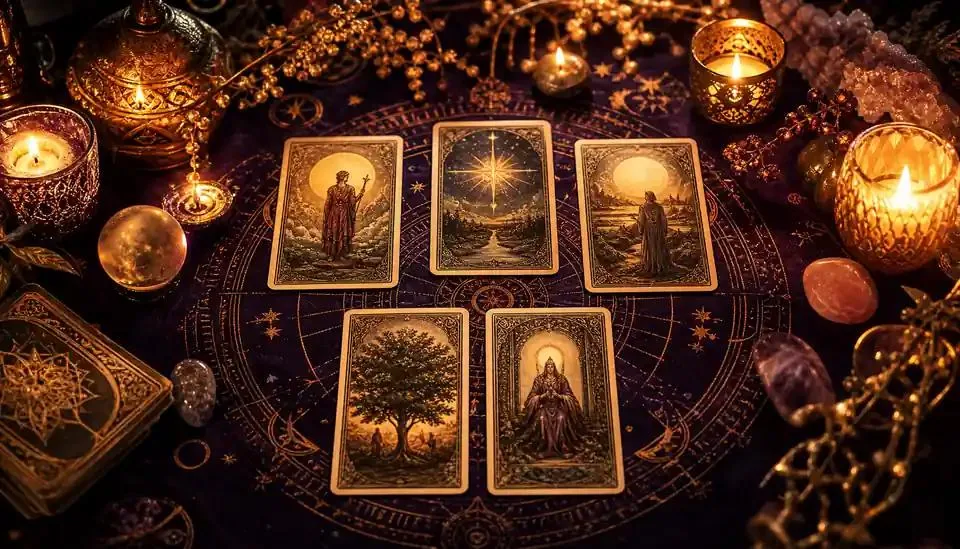
This Samhain tarot spread explores five aspects of your journey: the strength you inherited, the patterns you are ready to understand, the guidance you need now, the actions that honor your roots, and the legacy you want to leave behind.

Take your time with each card. Notice its imagery, the emotion it awakens, and the memories or thoughts that come to mind.
You do not need to interpret every symbol perfectly. The most useful insight may be the question a card encourages you to ask.
Card 1: The Root - What Strength Have I Inherited?
The Root represents the gifts that have traveled through your family history and helped shape the person you are today.
These gifts may include perseverance, humor, resourcefulness, creativity, devotion, hospitality, or the ability to begin again after hardship.
Sometimes we overlook our inherited strengths because they feel ordinary. Perhaps you learned to care for others by watching a grandparent. Perhaps you carry a quiet determination that helped someone in your family survive difficult circumstances.
As you look at this card, consider what has supported you even when life felt uncertain.
Ask your tarot cards:
“What strength, wisdom, or loving quality from those who came before me can I honor and nurture in my life today?”
Reflect on these questions:
- Which family traditions have brought comfort or meaning into my life?
- What qualities do I admire in the people who helped raise or guide me?
- What strength do I possess that I rarely give myself credit for?
- How can I use this gift in a way that supports my well-being?
The Root reminds you that your history is not made only of wounds. There may be courage in your inheritance, too.
You are allowed to receive the gifts of the past without repeating every part of it.
Card 2: The Ghost - What Pattern Am I Ready to Release?
The Ghost represents the habits, fears, and old stories you are beginning to see more clearly.
The name is symbolic. It does not mean that something dark is following you or that an ancestor is responsible for your struggles.
Instead, it points toward what lingers: the silence no one questions, the fear that appears whenever life begins to feel secure, or the belief that love must always come with sacrifice.
Perhaps you learned that expressing sadness made you a burden. Perhaps you feel responsible for keeping everyone happy. Perhaps you find yourself repeating a familiar relationship pattern even though you promised yourself you would choose differently.
The purpose of this card is not to assign blame. It is to bring awareness to something that may deserve a more compassionate response.
Ask your tarot cards:
“What inherited belief, emotional habit, or family pattern am I ready to understand and change?”
Then reflect:
- What happens repeatedly in my relationships or family life?
- Which beliefs about love, money, success, or safety did I absorb growing up?
- Am I holding on to a survival strategy that no longer serves me?
- What would change if I responded to this situation with greater freedom?
If this card brings up grief or discomfort, take a breath. You do not need to uncover everything at once.
You are not responsible for fixing your entire family history. You can begin with one small choice: speaking honestly, resting without guilt, asking for support, or setting a boundary that protects your peace.
Sometimes a generational pattern begins to change when one person learns that another response is possible.
Card 3: The Whisper - What Wisdom Do I Need Now?
The Whisper represents the guidance you are seeking in the present moment.
At Samhain, when the world grows quieter and the days become shorter, this card invites you to listen beneath the noise of daily expectations.
You may be standing at a crossroads. You may be reconsidering a relationship, grieving someone you miss, questioning a long-held belief, or wondering how to move forward without repeating the past.
Rather than treating this card as a literal message from the dead, allow it to become a conversation with your intuition, your values, and the wisdom you have gathered through experience.
Imagine what a loving, wise elder might encourage you to remember. What would someone who genuinely wanted your happiness want you to know?
Ask your tarot cards:
“What wisdom can help me move through this season with greater clarity, courage, and compassion?”
Consider:
- What truth have I been avoiding because it feels difficult?
- Where would patience serve me better than urgency?
- What part of myself needs more attention or kindness?
- What is the next honest step I can take?
A card such as the Hermit might invite solitude and reflection. The Star may remind you that hope can return slowly. Strength could encourage patience with yourself, while the High Priestess may invite you to trust your quiet inner knowing.
Your interpretation does not have to match anyone else's.
The Whisper reminds you that guidance is most meaningful when it helps you live more consciously in the world you inhabit today.
Card 4: The Offering - How Can I Honor My Roots Through Action?
Remembrance becomes especially meaningful when it changes how we live.
The Offering represents the everyday choices through which you express gratitude, honor your history, and bring your spiritual insights into your relationships and community.
You might preserve a family recipe, tell a story about someone you loved, learn the meaning of a forgotten tradition, or create a small space dedicated to remembrance.
You might also honor your ancestors by choosing something they could not choose for themselves: rest instead of constant sacrifice, honesty instead of silence, or a healthy boundary instead of an obligation that causes harm.
If a family tradition is painful, you are not required to continue it. Sometimes the most loving offering is to begin a new tradition.
Ask your tarot cards:
“What meaningful action can help me honor the wisdom of the past while living more fully in the present?”
Your answer might be surprisingly simple:
- Call someone who has shared meaningful stories about your family.
- Write down a memory before it fades.
- Cook a meal that connects you to a place or person you cherish.
- Place flowers or a photograph on a remembrance altar.
- Make amends where appropriate, while respecting your own boundaries.
- Practice a new habit that supports the emotional well-being of your household.
An offering does not need to be expensive, elaborate, or supernatural.
The most meaningful offering may be the way you treat people, the care you give yourself, and the love you make room for in ordinary life.
Card 5: The Seed - What Legacy Am I Creating?
The Seed brings your reading into the future.
You cannot change every event that shaped your family. You cannot rewrite another person's choices or know how every part of your story will unfold.
But you can influence what happens next.
Every time you choose compassion over cruelty, honesty over avoidance, or self-respect over an unhealthy obligation, you help shape the emotional world around you.
Your legacy is not limited to having children or passing down a family name. It lives in the people you encourage, the traditions you create, the art you make, the communities you nurture, and the way you respond when someone needs kindness.
Ask your tarot cards:
“What am I being invited to cultivate so that my life contributes to a more loving and conscious future?”
Reflect on:
- What do I want the people closest to me to remember about how I made them feel?
- Which values do I want to embody consistently?
- What can I teach through my actions rather than my words?
- What small change today could make tomorrow gentler?
The Seed is a reminder that healing is not only about what ends. It is also about what becomes possible afterward.
You are allowed to build a life that honors your origins without being confined by them.
How to Interpret Difficult Cards in an Ancestral Tarot Reading
Some tarot cards may feel unsettling when they appear in a reading about family history. The Ten of Swords, Three of Swords, Five of Pentacles, or Devil can bring up themes of loss, hardship, attachment, or fear.
These cards do not prove that your family is cursed, that an ancestor is unhappy, or that something terrible will happen.
Tarot is a symbolic practice, and its images can be interpreted in many ways. A difficult card may invite you to consider a painful memory, recognize a boundary that needs strengthening, or acknowledge an emotion you have been avoiding.
Try asking what the card helps you notice rather than what it threatens to reveal.
For example:
- Three of Swords: Is there grief that deserves acknowledgment and care?
- Ten of Wands: Am I carrying responsibilities that are not mine alone?
- Five of Pentacles: Where might I need support rather than trying to manage everything by myself?
- The Devil: What attachment, fear, or limiting belief would I like to understand more clearly?
- Death: What chapter of my life is ready to end so something new can begin?
These are reflective possibilities, not fixed meanings or predictions.
If a reading feels overwhelming, pause. Put the cards away, take a walk, speak with someone you trust, or return to the practice another day. You never need to push yourself through an emotionally difficult experience to make a ritual meaningful.
What If You Have a Painful or Estranged Family History?
Not everyone experiences ancestry as a source of comfort.
For some people, family history includes abandonment, abuse, estrangement, discrimination, or unresolved grief. Samhain can bring these feelings to the surface, especially when cultural messages suggest that family reconciliation is always desirable.
It is not.
You can honor your origins without excusing harm. You can acknowledge where you came from without inviting unsafe people back into your life.
If the idea of connecting with biological ancestors does not feel right, adapt this tarot spread to honor your chosen family, spiritual teachers, community elders, or the generations of people whose courage and creativity inspire you.
You can dedicate your reading to the qualities you want to cultivate rather than to particular individuals.
For example, you might focus on the legacy of kindness, the wisdom of those who protected vulnerable people, or the strength of people who built more compassionate communities.
You may also choose to focus entirely on yourself: the roots that sustain you, the patterns you want to change, the guidance you need, the care you can offer, and the future you wish to create.
Your spiritual practice should leave room for your truth.
You do not owe anyone access to your life in order to honor your past.
How to Close Your Samhain Tarot Ritual
When you have turned over all five cards, take a few minutes to let the reading settle.
You do not need to find a profound message in every card. Sometimes a single question will stay with you, and its meaning will become clearer through ordinary experiences over the following days.
1. Offer a moment of gratitude
Place your hands over your heart or rest them gently on the table.
If you have been remembering ancestors, loved ones, or spiritual guides, offer a quiet expression of thanks. If your reading has focused on personal reflection, thank yourself for making time to listen.
You might say:
“I honor the lives and stories that have shaped me. I receive the wisdom that helps me grow, release what I am ready to leave behind, and meet the future with a more open heart. May the lessons of this moment become acts of love in my everyday life.”
2. Close the space
Take a final look at your cards, then gather them and return them to your deck.
If you lit a candle, extinguish it safely. You can leave your altar in place for continued remembrance or clear it away when you feel ready.
There is no need to fear lingering energies or believe you have opened a doorway that must be sealed in a particular way. Closing the ritual is simply a helpful way to mark the end of your reflective time.
3. Return to the present
Drink some water, stretch, eat something nourishing, or step outside for fresh air.
Notice your surroundings. Feel the ground beneath your feet and allow yourself to return to the rhythm of your day.
If your reading stirred strong emotions, give yourself time to settle before interpreting everything or making important decisions.
4. Journal the wisdom you want to carry forward
Write down the names of your five cards and any thoughts, feelings, or memories that arose.
You may wish to record:
- The strength you want to honor.
- The pattern you want to understand.
- The guidance you want to remember.
- The action you intend to take.
- The legacy you hope to cultivate.
Choose one small, practical action to carry into the coming week. It might be a conversation, a boundary, a family story you want to preserve, or a moment of rest you have been denying yourself.
The ritual becomes more meaningful when its insights have a place in your everyday life.
A Samhain Blessing for Ancestral Healing
As the nights grow longer and the earth rests beneath autumn's fading colors, may you find comfort in the roots that sustain you.
May you remember the courage of those who came before you without feeling bound to repeat their hardships.
May you honor the love you received, grieve what was missing, and find the freedom to choose what comes next.
May the stories you carry become a source of understanding rather than a weight upon your spirit.
And may every act of healing, however small, become a seed of greater kindness in the world you leave behind.
Blessed Samhain. May you walk gently between remembrance and renewal.
Pull a tarot card
Hold a question in mind and draw one card from the full 78-card deck, upright or reversed.
Frequently asked questions
What is a Samhain tarot spread?
What is the best tarot spread for ancestral healing?
How do you honor your ancestors during Samhain?
Does the veil really become thinner at Samhain?
Can tarot help with generational trauma?
What if I draw a frightening tarot card during my Samhain reading?
Can I use this ancestral tarot spread if I am estranged from my family?
Can I use the Samhain Veil Spread at other times of the year?
Which tarot deck is best for Samhain readings?
What should I do after an ancestral tarot reading?
Keep reading

Across Psychic Pulse
The same themes, seen through another practice.