Ancestor Visits in Dreams: 4 Signs of a Meaningful Spiritual Encounter
Have you ever dreamed of a departed loved one and awakened with the feeling that you had truly been together again? Explore the spiritual meaning of ancestor visits in dreams, the symbols that may carry ancestral wisdom, and gentle practices for finding comfort, healing, and connection.
In this article (9)
Some dreams disappear almost as soon as we open our eyes. Others stay with us for years.
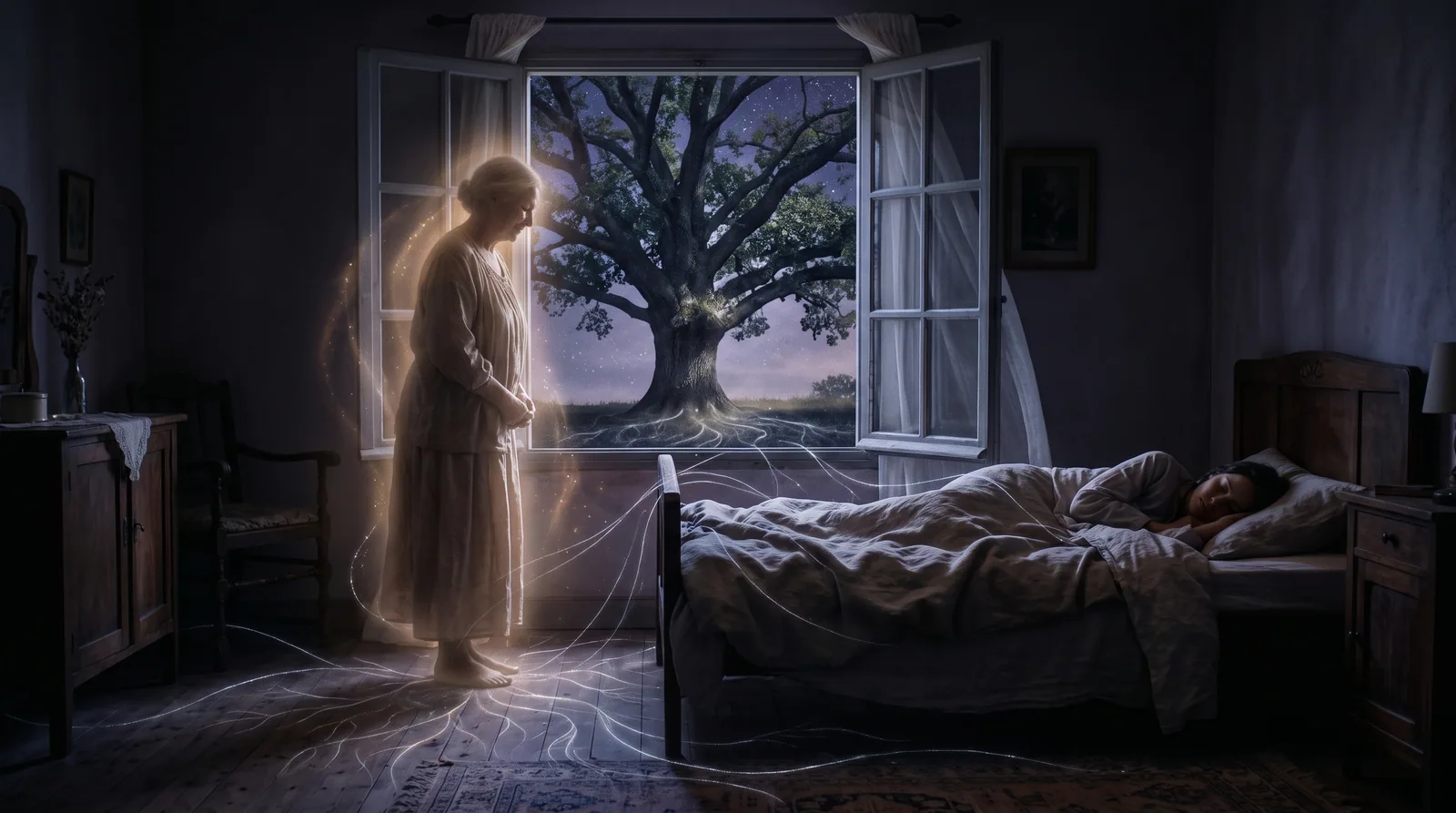
You might dream of your grandmother standing in a familiar doorway, your father smiling without saying a word, or an unfamiliar elder whose presence somehow feels deeply known. Perhaps the dream is unusually vivid. Perhaps you wake with tears in your eyes, a feeling of peace in your heart, or a quiet sense that something important has happened.
When a departed loved one appears in a dream, it can feel like more than remembering someone you miss.
Across many spiritual traditions, dreams have long been regarded as places where the living can encounter ancestral wisdom, receive symbolic guidance, and reconnect with the people whose lives helped shape their own. Others understand these dreams as expressions of grief, memory, and the enduring bonds of love.
You do not have to choose a single explanation immediately.
An ancestor dream can be meaningful whether you understand it as a spiritual visitation, a message from your unconscious, or a beautiful meeting created by the heart. What matters is approaching the experience with openness, discernment, and respect for what it brings to the surface.
If you have recently dreamed of a deceased relative, here are four signs that the experience may hold particular spiritual significance, and ways to work with the dream after waking.
What Does It Mean When an Ancestor Visits You in a Dream?
An ancestor dream is a dream in which a deceased family member, elder, or figure connected to your lineage appears and seems to offer comfort, recognition, guidance, or a meaningful presence.
Spiritually, ancestor visits in dreams are often interpreted as moments of remembrance and connection. They may invite you to reconnect with your roots, recognize inherited strengths, make peace with the past, or pay attention to a part of your life that needs care.
Sometimes the dream features someone you knew intimately. Other times, you may encounter a great-grandparent you never met, an unknown elder, or a figure who feels ancestral without having a recognizable face.
These experiences can carry different meanings depending on your personal history, cultural background, relationship with the deceased, and feelings during the dream.
An ancestor appearing in a dream does not automatically mean that a spirit has contacted you. There is no reliable way to prove a supernatural visitation from dream details alone. Yet the emotional and spiritual meaning of the experience can still be profound.
Rather than asking only, Was this real?, consider another question:
What did this encounter awaken in me, and what might I learn from it?
That question allows you to honor the mystery without surrendering your own judgment.
The Spiritual Meaning of Ancestral Dreams
Our ancestors live in our lives in more ways than we sometimes realize.
They live through the stories we tell, the traditions we preserve, the gestures we inherit, the recipes passed down through generations, and the values that quietly shape our decisions. They may also live in the family patterns we are trying to understand or change.
Dreams can bring these connections into focus.
Psychologist Carl Jung explored the idea of a collective unconscious: a deeper dimension of the psyche expressed through recurring human symbols and archetypes. His work offers one way to understand why certain dream figures, including wise elders and ancestral guides, can feel so powerful.
From a spiritual perspective, an ancestor may symbolize protection, belonging, continuity, or wisdom that reaches beyond an individual lifetime. From a psychological perspective, the same figure may represent memories, emotional needs, family history, or qualities you are learning to embody.
Neither interpretation needs to erase the other.
An ancestor appearing in a dream may invite you to remember where you came from while deciding, consciously, what you want to carry forward.
This is especially meaningful when you are moving through grief, becoming a parent, making a major life decision, reconnecting with your heritage, or breaking a painful family pattern.
Sometimes the dream is not asking you to look backward. It is helping you move forward with a deeper understanding of your roots.
4 Signs Your Ancestor Dream May Be Spiritually Meaningful
No single detail can prove that a dream was a supernatural visitation. However, certain qualities may help explain why an experience feels different from an ordinary dream and why it deserves your attention.
1. The Dream Feels Unusually Vivid and Peaceful
One of the most commonly described features of visitation dreams is their remarkable clarity.
You may remember the color of a loved one's clothing, the expression in their eyes, the warmth of their smile, or the familiar surroundings in which you met. The dream may unfold with an unusual sense of stillness, even if you cannot recall every detail.
Sometimes the most powerful part is not what happens. It is the feeling of being fully present with someone you thought you had lost.
You may awaken feeling comforted, surprised, emotional, or deeply moved.
Spiritually, you might experience this as a moment of connection across the boundary between life and death. Psychologically, vivid dreams can also emerge from strong emotional memories, grief, or periods of personal change.
You do not need to prove which explanation is correct before acknowledging what the experience meant to you.
A reflection to try: What made this dream stand out? Was it the person's presence, a particular expression, the setting, or the feeling you carried into the morning?
Write down the details before they fade. Sometimes the smallest image holds the greatest personal meaning.
2. Your Ancestor Offers a Gift, a Symbol, or a Few Meaningful Words
In many spiritual traditions, meaningful dreams communicate through symbols rather than lengthy explanations.
An ancestor might hand you a key, offer a flower, hold out a family photograph, give you a piece of jewelry, or simply place a reassuring hand on your shoulder.
Each image can invite a different kind of reflection.
A key may symbolize a new understanding or a door you are ready to open.
A seed may represent hope, potential, or something worth nurturing.
A ring or family heirloom may evoke belonging, commitment, inheritance, or the responsibilities you associate with your family.
Water may bring to mind emotional renewal, cleansing, or the need to let feelings move freely.
Words can carry meaning, too. A departed relative may tell you that you are loved, remind you of your strength, or appear during a period when you desperately need reassurance.
Rather than treating a symbol as a universal code, consider what it means to you. A ring given by your grandmother may hold a very different significance from a ring associated with a painful relationship.
If an ancestor offers advice, allow yourself time to reflect before acting. A dream can inspire useful questions, but it should not be treated as unquestionable authority over your health, relationships, finances, or future.
A reflection to try: If your ancestor gave you an object or spoke a particular phrase, ask yourself what that symbol represents in your own life. What feeling or memory does it bring forward?
3. The Encounter Feels Complete, as Though Something Has Been Expressed
Some ancestor dreams have a natural beginning and ending.
You meet your loved one. You share a moment, exchange a few words, or simply look at one another. Then the encounter ends, and you awaken with a sense that something important has been acknowledged.
For some people, this brings comfort after a loss. For others, it opens the door to unfinished feelings, unspoken words, or questions they have carried for years.
You may dream of a parent who never expressed affection in life and experience a moment of tenderness. You may see a grandparent who represents safety during a difficult transition. You may encounter a relative with whom you had a complicated relationship and find yourself ready to understand the past differently.
These dreams do not necessarily mean that every conflict has been resolved or that the deceased has communicated a literal message.
They can, however, create space for an emotional truth to emerge.
Perhaps you are ready to forgive yourself. Perhaps you need to acknowledge your anger. Perhaps you are discovering that you can love someone while also recognizing the harm they caused.
Ancestral healing does not require idealizing the people who came before you. You can honor their humanity, recognize their limitations, and choose a healthier path.
A reflection to try: What felt different when the dream ended? Did you feel comfort, sadness, relief, confusion, or a renewed sense of connection? Let your own emotional response guide your interpretation.
4. The Dream Stays With You Long After You Wake
Some dreams leave a lasting impression.
Days or even years later, you may remember the sound of your loved one's voice, the feeling of sitting beside them, or the quiet atmosphere surrounding the encounter.
A dream like this can return to your thoughts during anniversaries, family gatherings, personal milestones, or moments when you wish you could ask the deceased for advice.
In spiritual practice, this lasting quality may be understood as a sign that the dream carries a message for your inner life. In psychology, emotionally significant dreams may remain memorable because they connect with powerful memories, relationships, or unresolved feelings.
The important question is not how long you remember the dream, but how you relate to it.
Does remembering the dream help you feel connected to the love you shared? Does it encourage you to live more intentionally? Does it help you understand something about your family or yourself?
A meaningful dream does not have to predict the future or reveal hidden information. Sometimes its greatest gift is the reminder that love can continue to shape us long after someone has died.
A reflection to try: If you could carry one feeling from the dream into your waking life, what would you choose? Let that feeling become a gentle intention for the days ahead.
What If You Dream of an Ancestor You Never Met?
Dreaming of an ancestor you never knew can feel especially mysterious.
You might see a great-grandmother whose photograph you have only seen once, encounter an unfamiliar elder who feels connected to your family, or dream of someone whose identity remains unknown.
There are several ways to approach this experience.
Spiritually, you may interpret the figure as a symbol of ancestral presence, inherited wisdom, or a desire to reconnect with your roots. Psychologically, the figure may represent qualities associated with elders, family belonging, or parts of your identity that are still developing.
The dream may also inspire a practical exploration of your family history.
You could ask relatives about their memories, learn about the places your family came from, revisit old photographs, or explore traditions that have been lost over time.
You do not need to identify the dream figure to benefit from the encounter.
Consider what the person represented. Did they seem protective, joyful, sorrowful, wise, or unfamiliar? Did the dream evoke a sense of belonging or reveal questions about your heritage?
Sometimes an unknown ancestor in a dream is less about discovering a particular person and more about discovering your relationship with the generations that came before you.
Can Ancestor Dreams Help With Generational Healing?
Many people begin exploring ancestral dreams when they are trying to understand family patterns.
Perhaps several generations have struggled to express emotion. Perhaps your family has experienced repeated displacement, conflict, loss, or silence around painful events. Perhaps you have noticed that certain beliefs about love, money, responsibility, or self-worth continue to shape the lives of family members.
An ancestor dream may bring these themes into awareness.
It cannot establish that a particular trauma has been biologically inherited or that a deceased relative has asked you to resolve it. But it can become a meaningful starting point for reflecting on the patterns you have received and the ones you want to change.
Generational healing begins with awareness, compassion, and choice.
You can honor your ancestors without repeating every lesson they learned under difficult circumstances. You can appreciate their sacrifices without believing you must carry their suffering. You can preserve family traditions while creating new ones that better reflect your values.
Try asking yourself:
- What strengths have I inherited from the people who came before me?
- What family beliefs have helped me, and which ones have limited me?
- What pain deserves acknowledgment rather than silence?
- What would it mean to create a healthier legacy for the next generation?
You do not need to heal an entire family history in one lifetime.
Sometimes the most meaningful act of ancestral healing is learning to communicate honestly, choosing a healthier relationship, asking for help, or allowing yourself to rest without guilt.
You can honor the past while refusing to let it dictate your future.
A Gentle Ritual to Honor an Ancestor Dream
If a dream of a departed loved one has touched you deeply, a simple ritual can help you preserve the memory and reflect on its meaning.
You do not need special tools, expensive objects, or a complicated spiritual practice. What matters is the intention you bring to the moment.
Step 1: Create a Quiet Space
Choose a peaceful place where you can sit without interruption.
You might place a photograph of your loved one nearby, hold an object that reminds you of them, or simply sit in silence. If you enjoy working with candles, use one safely. A candle is not necessary for the ritual to be meaningful.
Take a few slow breaths and allow yourself to remember the dream without forcing it to make sense.
Step 2: Speak Their Name
If it feels comforting, say your ancestor's name aloud.
You might share what you remember, what you miss, or what you wish you could have told them. You can also express gratitude for the qualities you continue to carry from them.
If your relationship was difficult, you do not have to offer forgiveness or affection that you do not genuinely feel.
Honesty is part of healing.
Step 3: Write Down the Dream
Record the experience as soon as you can, including:
- The encounter: Who appeared, where you were, and what happened.
- The symbols: Objects, colors, words, gestures, or familiar places.
- The emotions: How you felt during the dream and after waking.
- The personal connection: What the dream brings to mind in your current life.
- The next step: One small, grounded action inspired by your reflection.
You do not need to interpret every detail. Leave room for uncertainty and allow your understanding to develop over time.
Step 4: Choose What You Want to Carry Forward
Finish the ritual by asking yourself what you want to take from the experience.
Perhaps it is courage, patience, tenderness, resilience, or a renewed appreciation for family.
You might say:
I honor the lives that came before me. I receive the love, wisdom, and strength that help me grow. I acknowledge the pain that deserves healing, and I choose to carry forward what supports a more compassionate future.
Adapt these words to your own beliefs. If prayer feels natural, pray. If quiet reflection feels more authentic, let silence be enough.
The purpose is not to force a supernatural encounter or obtain a guaranteed answer. It is to make space for remembrance, meaning, and a conscious relationship with your own history.
What If the Ancestor Dream Feels Frightening?
Not every dream involving a deceased relative is peaceful.
You may dream of someone who hurt you, encounter a loved one who appears angry or distressed, or wake with a sense of fear that stays with you throughout the day.
A frightening dream does not mean that an ancestor is angry with you, that something terrible will happen, or that you are spiritually unsafe.
Dreams can bring difficult memories and emotions to the surface, sometimes in unsettling forms. If the person caused you harm in life, their appearance does not obligate you to trust, forgive, or reconnect with them.
You can set emotional boundaries even within your spiritual practice.
After a distressing dream, take a moment to ground yourself. Notice your surroundings, drink some water, write down what happened, and remind yourself that a dream is not a prediction. If the experience continues to cause distress or disrupts your sleep, consider speaking with a qualified mental health professional.
Spiritual reflection and practical care can coexist.
You are allowed to approach the unknown slowly, protect your peace, and decide what feels healthy for you.
How to Keep an Ancestor Dream Journal
A dream journal can help you notice recurring themes without feeling pressured to find a hidden message in every dream.
Keep a notebook beside your bed or use a private digital note. When you wake, write whatever you remember before the details begin to fade.
For each ancestor dream, consider these five prompts:
1. Who appeared?
Record the person's name, relationship to you, or any details about an unfamiliar figure.
2. What happened?
Describe the setting, conversation, gestures, objects, and ending as clearly as you can.
3. What did you feel?
Note whether the dream brought comfort, longing, sadness, joy, fear, or a mixture of emotions.
4. What does it connect to in your life?
Consider whether you are facing a transition, grieving a loss, exploring your heritage, or reflecting on a family relationship.
5. What meaning feels helpful and grounded?
Write down any interpretation that resonates, while allowing for the possibility that the dream may have more than one meaning, or no single clear meaning at all.
Over time, you may notice that particular relatives appear during certain life transitions or that recurring symbols reflect themes you are working through.
Treat these patterns as invitations to reflect rather than proof of supernatural instructions.
Your journal belongs to you. There is no correct way to dream, remember, or understand the people who have shaped your life.
Final Blessing: May Your Roots Give You Strength
There are dreams that remind us how deeply we have loved, how much we still miss, and how the past continues to live within our hearts.
When an ancestor appears in your dreams, you do not have to solve the mystery immediately. You can welcome the comfort, acknowledge the questions, and give yourself time to understand what the experience means to you.
Perhaps you experience the dream as a spiritual visitation. Perhaps it is your heart revisiting a treasured relationship. Perhaps it is a meeting place where memory, longing, and hope come together.
Whatever interpretation you hold, let it lead you toward greater compassion rather than fear.
May you remember the courage of those who came before you, recognize the gifts you have received, and find the freedom to leave painful patterns behind.
May you honor your roots without being bound by them.
And may the love worth carrying forward become a living presence in the way you care for yourself, your family, and the world around you.
Frequently asked questions
What does it mean when you dream of a deceased ancestor?
How can you tell if a dream was a visitation from a deceased loved one?
Why do I dream about an ancestor I never met?
Can deceased loved ones communicate through dreams?
What does it mean when an ancestor gives you something in a dream?
What should I do after dreaming about a deceased family member?
Can ancestor dreams be connected to grief?
What does it mean if an ancestor appears angry or frightening in a dream?
Can ancestor dreams help with generational healing?
Keep reading



Across Psychic Pulse
The same themes, seen through another practice.