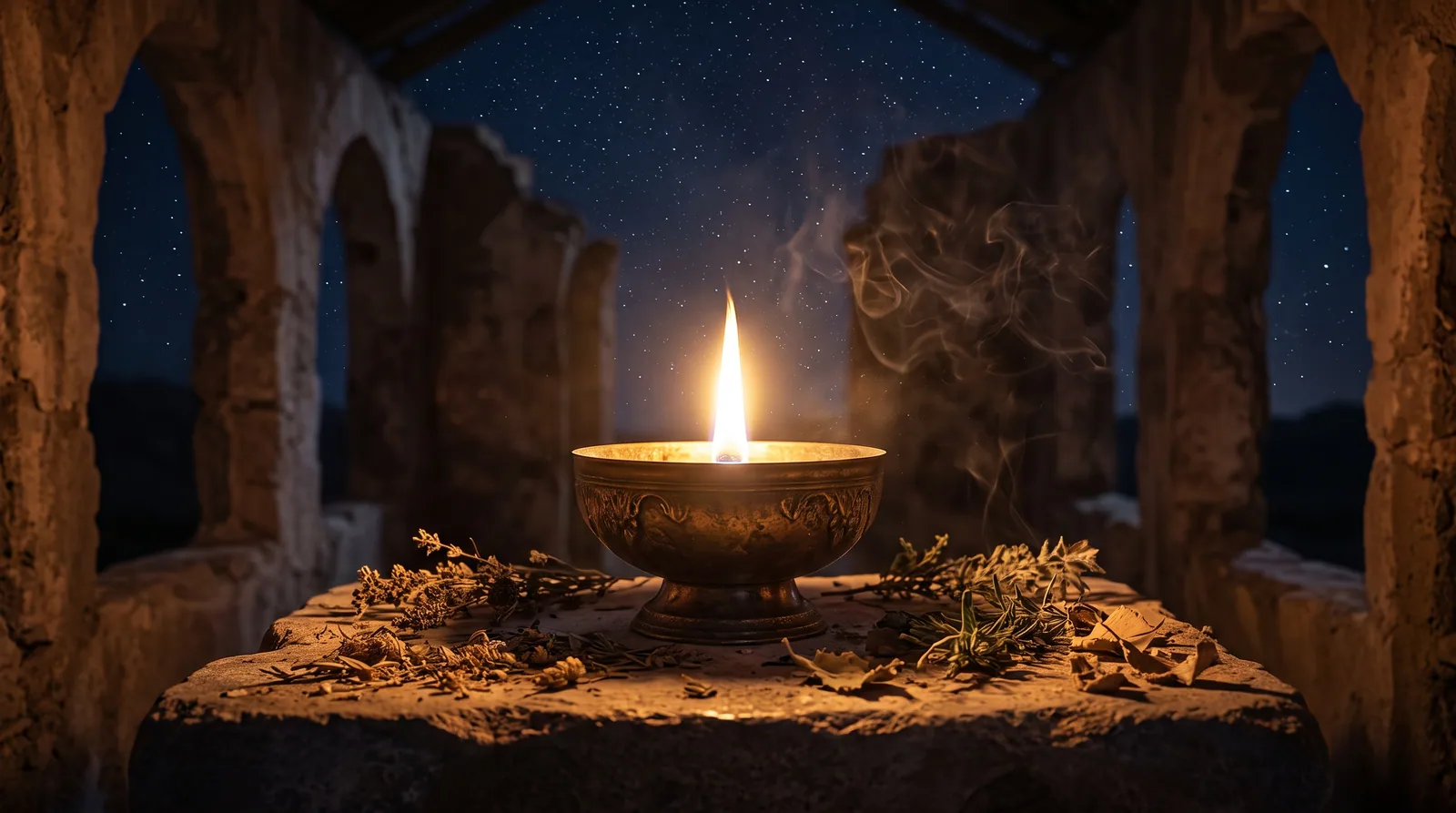
Dream Herbs: The Spiritual Traditions of Mugwort, Blue Lotus, and Chamomile
Throughout history, herbs have held a special place in the rituals surrounding sleep, dreams, and the mysteries of the night. Discover the folklore of mugwort, blue lotus, and chamomile, and learn how to create a mindful bedtime practice that honors both your inner world and your need for restorative rest.
In this article (8)
There is something sacred about the moment the world grows quiet.
The messages have been answered. The day's responsibilities begin to loosen their grip. Outside, the light fades, and the mind slowly turns inward. It is in this gentle transition that many spiritual traditions have found an invitation to listen more closely to the inner world.
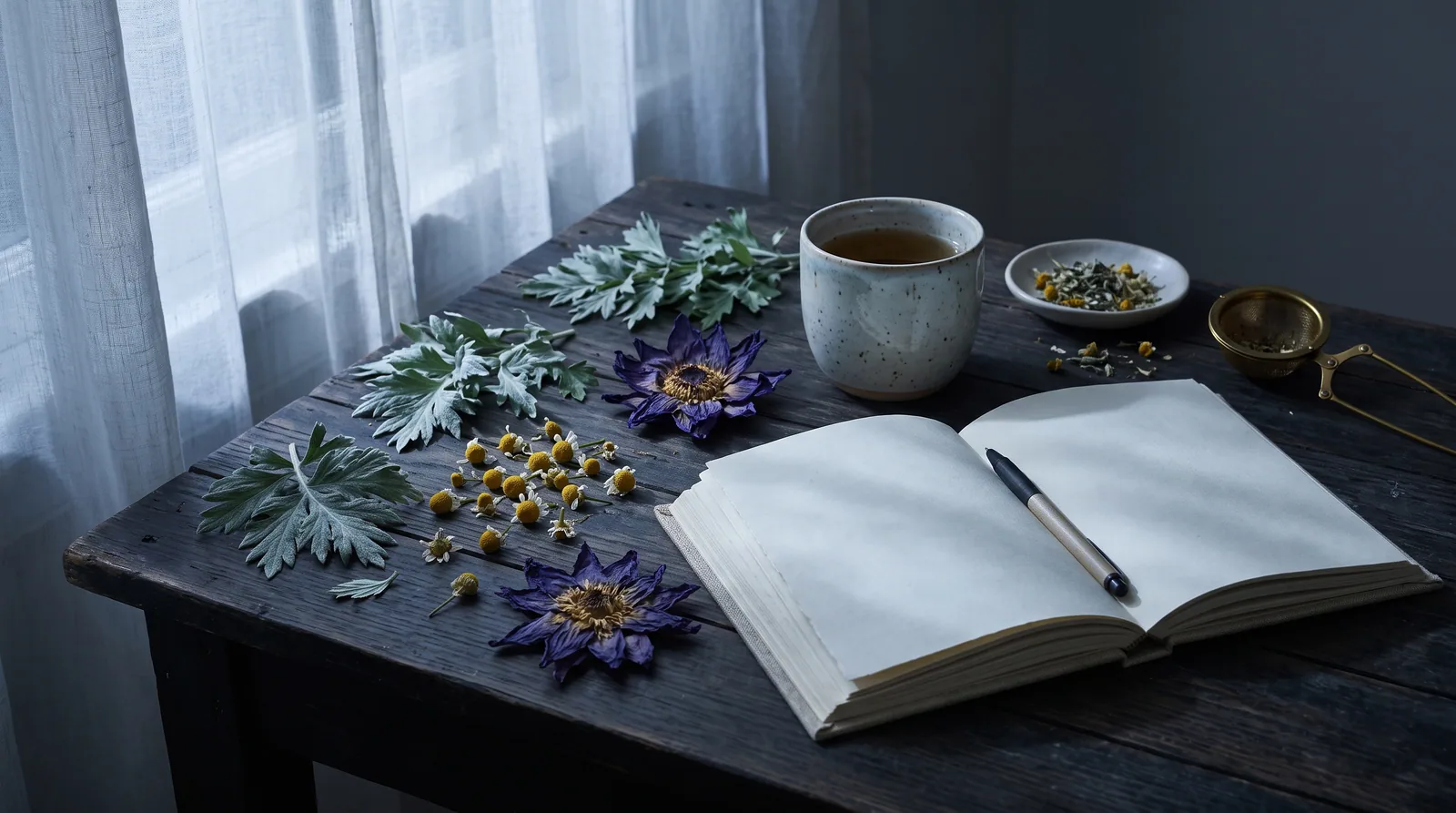
For centuries, people across different cultures have associated certain plants with sleep, dreams, intuition, and spiritual reflection. Mugwort became a familiar companion in European and Asian dream folklore. Blue lotus appeared in the sacred imagery of ancient Egypt. Chamomile became a symbol of comfort, simplicity, and the soothing rhythms of nature.
These plants belong to different traditions, but they share a place in humanity's enduring relationship with the night.
Today, dreamwork offers a way to approach this relationship with curiosity. You do not need to interpret every dream as a prophecy or search for a hidden message in every image. Sometimes a dream simply reflects the emotions, memories, and experiences moving through you.
The purpose of a dream ritual is not to force a vision or control the unconscious. It is to create a peaceful space in which you can rest, remember, reflect, and become more attentive to your inner life.
Let's explore the spiritual symbolism of mugwort, blue lotus, and chamomile, along with gentle ways to bring the wisdom of botanical traditions into your nighttime practice.
What Are Dream Herbs?
Dream herbs are plants associated with sleep, dreams, remembrance, and spiritual reflection in traditional folklore and herbal practices.
Some are valued for their calming associations. Others appear in stories about dreams, visions, or sacred ceremonies. Their significance often comes from a combination of cultural history, sensory experience, personal ritual, and beliefs passed down through generations.
The term oneirogen is sometimes used for a substance believed to influence dreaming. However, not every herb traditionally associated with dreams has been scientifically shown to increase dream vividness, improve dream recall, or produce lucid dreams.
This distinction matters. Spiritual traditions can offer meaningful ways to approach sleep without every traditional claim needing to be treated as established science.
A dream herb can become part of your personal practice because its fragrance reminds you to slow down, because its history inspires reflection, or because preparing a bedtime ritual helps you transition away from the demands of the day.
You can explore dreamwork without consuming any herbs at all.
A quiet room, a few minutes of breathing, and a notebook beside your bed can be just as meaningful a beginning.
Mugwort: The Herb of Dreams, Mystery, and Inner Exploration
Mugwort (Artemisia vulgaris) has a long history in European and Asian folklore. It has been associated with protection, traditional healing, seasonal rituals, and the mysterious experiences that occur between waking and sleep.
Its name frequently appears in discussions of dream herbs because of its place in traditional dreamwork.
But mugwort's deeper spiritual appeal is not simply about having vivid dreams. It is about the willingness to enter the unknown with an open mind.
The spiritual meaning of mugwort
Mugwort can be understood as a symbol of the threshold: that delicate boundary between what we consciously know and what we have yet to understand.
In a symbolic dreamwork practice, this plant invites you to become curious about the images that emerge when your usual defenses soften.
Perhaps you dream about a place you have not visited in years. Perhaps an ordinary object appears with unusual emotional intensity. Perhaps you wake with a feeling that stays with you long after the details disappear.
Rather than immediately searching for a universal interpretation, pause and ask what the image means to you.
A house might represent safety to one person and confinement to another. A river might feel like renewal, uncertainty, or grief. The emotional context of the dream is often more personally meaningful than a fixed symbol dictionary.
Mugwort's folklore offers a fitting reminder: the inner world does not always speak in direct explanations. Sometimes it speaks through atmosphere, memory, metaphor, and feeling.
Mugwort and dream recall
Mugwort is traditionally associated with vivid dreams and dream awareness, but reliable clinical evidence that it consistently enhances dreaming remains limited.
If you are interested in exploring its folklore, you can begin with a symbolic ritual that does not involve ingesting the plant.
Place a botanical illustration of mugwort in your journal, read about its traditional history, or simply use it as a visual reminder of your intention to remember your dreams.
Before sleep, ask yourself:
What might I notice if I approach my dreams with curiosity rather than judgment?
Then let the question rest. You do not need to demand an answer from the night.
A gentle mugwort-inspired dream ritual
- Settle into a comfortable position and allow your breathing to become natural and unforced.
- Write down one question you would like to reflect on, preferably about your emotions or personal growth.
- Close your journal and give yourself permission to rest without expecting a particular dream.
- In the morning, record whatever remains: a scene, a color, a sensation, or even the absence of a clear memory.
The ritual is about attention, not control.
A note on safety: Mugwort is not suitable for everyone. Avoid ingesting it during pregnancy, and seek professional advice before using it medicinally, particularly if you have allergies to plants in the Asteraceae family or take medication. Do not assume that a dried-herb sachet or essential oil is automatically safe simply because it is used externally.
Blue Lotus: Beauty, Renewal, and the Mystery of Consciousness
The blue lotus (Nymphaea caerulea), often called the Egyptian blue water lily, occupies an evocative place in ancient Egyptian art and religious imagery.
Its distinctive blue petals and golden center made it a striking symbol in a culture deeply attentive to cycles of life, death, renewal, and rebirth.
Blue lotus is often discussed in modern spiritual circles as a plant connected with altered states, dream exploration, and mystical experiences. Historical depictions and contemporary interpretations, however, should not be confused with proof that it reliably produces specific psychological or dream effects.
Its symbolism alone offers a rich starting point for contemplation.
The spiritual meaning of blue lotus
A flower rising from water can become a powerful image of renewal.
Water has long served as a spiritual symbol of emotion, mystery, and the unseen. A flower emerging from it suggests the possibility of beauty arising from conditions we cannot fully control.
In this sense, blue lotus can represent the quiet emergence of insight.
You may not always understand what you are feeling while you are in the middle of a difficult season. Sometimes clarity arrives later, after you have rested, allowed an emotion to settle, or looked at a situation from a different perspective.
Blue lotus offers a symbolic reminder that understanding does not always come through effort. Some realizations need room to unfold.
Blue lotus and the dream world
The association between blue lotus and altered states has made it a popular subject among modern dreamwork enthusiasts. Yet strong scientific evidence that blue lotus improves dream recall or reliably induces lucid dreams is lacking.
You can still draw on its imagery without using the plant as a psychoactive substance.
Imagine a blue lotus opening slowly on still water. Let the image become a meditation on patience, emotional renewal, or the possibility of beginning again.
Ask yourself:
What part of my life is asking to open in its own time?
There is no need to force an answer. The question itself can create a little more space for reflection.
A blue lotus-inspired evening meditation
Before bed, dim the lights and sit quietly for a few minutes.
Picture a flower resting on calm water beneath the evening sky. With each comfortable breath, imagine the surface becoming a little more peaceful.
Bring to mind one emotion you have been carrying throughout the day. You do not need to change it, solve it, or push it away. Simply acknowledge that it is there.
When you feel ready, write one sentence in your journal beginning with:
Tonight, I give myself permission to…
Let the sentence be honest and simple.
A note on safety: Blue lotus products vary in composition and strength, and their safety and effects are not well established. Avoid assuming that extracts, tinctures, or concentrated products are harmless or suitable for sleep. Consult a qualified healthcare professional before using them, especially if you take medication or have an underlying health condition. Do not combine psychoactive products with alcohol or sedating substances.
Chamomile: Comfort, Peace, and the Art of Letting Go
Chamomile has one of the most familiar places in everyday bedtime traditions. Its gentle fragrance, delicate blossoms, and association with a warm evening cup make it a natural symbol of comfort and simplicity.
Unlike plants celebrated primarily for their mysterious associations, chamomile reminds us that spiritual practice does not always need to be dramatic.
Sometimes the most meaningful ritual is the one that tells the body and mind: the day is finished, and you may rest.
The spiritual meaning of chamomile
Chamomile can symbolize gentleness, patience, and the restoration of balance.
Its small blossoms offer a useful metaphor for the quiet forms of care we often overlook. We tend to associate transformation with major decisions, powerful revelations, or sudden breakthroughs. Yet much of our emotional life changes through smaller acts of kindness toward ourselves.
Going to bed instead of continuing to work. Allowing a difficult conversation to wait until morning. Releasing the expectation that every problem must be solved before we can rest.
These ordinary choices can become spiritual practices when they are made with intention.
Chamomile invites you to stop treating rest as a reward you must earn.
Chamomile and peaceful sleep
Chamomile tea is traditionally used as a calming bedtime drink. Some research has explored chamomile and sleep, but the evidence is limited and does not establish that it reliably treats insomnia or guarantees deeper sleep.
Its place in a bedtime routine may also come from the comfort of a familiar warm drink and the consistency of a relaxing ritual.
A cup of chamomile tea, if suitable for you, can mark the transition from activity to rest. You might enjoy it while reading a few pages, writing in your journal, or sitting quietly without a screen.
The intention is not to force sleep. It is to create conditions in which rest feels more welcome.
A chamomile-inspired ritual for releasing the day
As evening approaches, take a few minutes to consider three things:
- What am I ready to set down? Identify one worry you do not need to solve tonight.
- What deserves gratitude? Recall a small moment of comfort, connection, or beauty.
- What can wait until tomorrow? Give yourself permission to stop carrying tomorrow's responsibilities into tonight.
If you enjoy chamomile tea and know it is safe for you, you may include a familiar, commercially prepared tea in this ritual. You can also choose warm water or another comforting drink.
A note on safety: Chamomile can cause allergic reactions, particularly in people sensitive to ragweed and related plants. It may also interact with certain medications. If you are pregnant, breastfeeding, taking medication, or managing a medical condition, ask a qualified healthcare professional about its suitability.
How to Create a Spiritual Dreamwork Ritual
You do not need a complicated herbal blend to create a meaningful relationship with your dreams.
A consistent nighttime ritual can help you slow down, notice your emotional state, and make space for reflection. The following practice brings together the symbolism of mugwort, blue lotus, and chamomile without requiring you to ingest them.
Step 1: Create a peaceful space
Reduce unnecessary light and noise. Put your phone aside if possible, and keep your bedroom comfortable.
You might place a botanical illustration, a flower, or a small object that reminds you of nature beside your bed.
Let this space represent a transition away from the demands of the day.
Step 2: Choose your intention
Choose one gentle intention for the night.
You might wish to remember your dreams, understand an emotion, cultivate gratitude, or simply sleep peacefully.
Avoid treating the intention as a test you must pass. Remembering no dreams is not a failure, and a vivid dream does not necessarily contain a hidden message.
Step 3: Use a sensory anchor
Choose something that helps you feel present and settled.
It could be the warmth of a familiar caffeine-free drink, the texture of your journal, a soft blanket, or the sight of a botanical image.
If you use herbal products, keep safety in mind. Avoid placing loose plant material or essential oils where they could irritate your skin or airways, and do not assume that a scented pillow will improve dreaming.
The purpose of a sensory anchor is to support comfort, not to stimulate a particular dream state.
Step 4: Record your dreams without judging them
Keep a notebook beside your bed.
When you wake, remain still for a moment if comfortable and notice what you remember. You might recall a complete story, a single image, an emotion, or nothing at all.
Write down whatever is available before becoming absorbed in the day's activities.
Useful prompts include:
- What was the strongest feeling in the dream?
- Did any place, person, or object stand out?
- Did the dream remind me of something happening in my life?
- What interpretation feels personally meaningful, without assuming it must be true?
Your dream journal is not a place where you have to decode yourself perfectly. It is a place where you can listen without rushing to conclusions.
Step 5: Reflect in the morning
Give yourself a few quiet minutes to revisit what you wrote.
Rather than asking, "What does this dream predict?", try asking, "What does this dream bring to mind?"
Dreams can reflect memories, emotional concerns, everyday experiences, and imaginative associations. Their meaning is not always clear, and there is no single interpretation that applies to everyone.
Let your reflection be an invitation rather than a verdict.
Herbal Dream Pillows: Tradition, Symbolism, and Safety
Herbal dream pillows are small fabric pouches containing dried botanicals. In various folk and contemporary spiritual practices, scented plant materials have been used to create a comforting atmosphere around bedtime.
Today, they are sometimes associated with dream recall and lucid dreaming. However, reliable evidence that dream pillows cause vivid dreams or improve memory of dreams is limited.
You can approach one as a symbolic object rather than a treatment.
For example, a small linen pouch containing dried chamomile may remind you to approach the evening gently. A botanical illustration of mugwort may represent curiosity about your inner world. An image of blue lotus may become a personal symbol of renewal.
If you choose to use a physical pouch, keep it beside the bed rather than directly against your face. Ensure the contents are correctly identified, fully dry, and safely contained. Avoid it if you have plant allergies, asthma, fragrance sensitivity, or irritation from the materials.
Do not add concentrated essential oils to a pillow or assume that inhaling plant compounds is risk-free. Keep botanical materials away from children and pets.
Most importantly, remember that you can honor the tradition without needing to use any herb at all.
Protecting Your Sleep While Exploring Dreamwork
Dreams can feel mysterious, but healthy sleep remains essential.
A spiritual practice should support your well-being rather than turn the night into another task to optimize. The goal is not to maximize dream intensity at the expense of feeling rested in the morning.
Keep these principles in mind:
Prioritize regular sleep. A consistent bedtime and wake-up time can help support your natural sleep-wake rhythm.
Avoid experimenting with multiple herbs at once. Combining botanicals can make it harder to understand their effects and may increase the risk of adverse reactions or interactions.
Do not rely on herbs to treat persistent sleep problems. If you regularly struggle to fall asleep, wake frequently, or feel exhausted during the day, speak with a qualified healthcare professional.
Be cautious with supplements and extracts. Products marketed for lucid dreaming or spiritual exploration may vary in strength, purity, and ingredients. Traditional use does not establish safety or effectiveness.
Allow dreams to be ordinary. Not every night needs to bring a revelation. Rest is valuable even when you remember nothing.
Avoid treating dreams as unquestionable guidance. Dreams may help you reflect on emotions, but major medical, financial, or relationship decisions deserve careful consideration of waking-life evidence and circumstances.
A Final Reflection: Let the Night Be a Place of Listening
Mugwort, blue lotus, and chamomile each offer a different symbolic doorway into the nighttime world.
Mugwort evokes mystery and the courage to explore the unfamiliar. Blue lotus suggests renewal and the slow unfolding of insight. Chamomile reminds us of gentleness, comfort, and the quiet wisdom of rest.
Their histories reveal how deeply human beings have searched for meaning in the transition between waking and sleep.
You can honor these traditions without believing that a particular plant will unlock hidden powers or guarantee a special dream. The spiritual value may lie in the attention you bring to the practice: the moment you stop, breathe, listen, and allow your inner life to exist without immediate explanation.
Tonight, you might begin with a single question:
What would change if I treated rest not as an interruption to my life, but as a meaningful part of it?
Write it down if you wish. Let the room grow quiet. Allow the question to accompany you into the night without demanding an answer.
Sometimes the deepest dreamwork begins with nothing more than the willingness to listen.
Frequently asked questions
What are the best herbs for dreamwork?
Does mugwort help you remember your dreams?
What is the spiritual meaning of blue lotus?
Is chamomile good for a bedtime ritual?
Can herbal dream pillows cause lucid dreams?
Is it safe to drink mugwort or blue lotus tea before bed?
How can I remember my dreams naturally?
Do dreams always have a spiritual meaning?
Keep reading



Across Psychic Pulse
The same themes, seen through another practice.