The Death Tarot Card: Spiritual Meaning, Transformation & Sacred Endings
The Death tarot card can feel frightening, but its deeper message is one of transformation. Explore the spiritual meaning of Card XIII, its symbolism, love and career interpretations, reversed meaning, and a four-card spread for navigating endings with greater clarity.
In this article (3)
The Death tarot card is one of the most misunderstood cards in the Major Arcana.
When Card XIII appears in a reading, many people immediately feel fear. But the Death card is rarely about literal death. Spiritually, it speaks to something much more human: the sacred ending of a chapter that has completed its purpose.
Death asks you to release what you have outgrown.
A relationship may be changing. An identity you once depended on may no longer feel like you. A career, belief, habit, or version of yourself may be quietly coming to an end.
That can hurt.
And that is part of the message.
The Death card does not ask you to pretend an ending feels good. It invites you to honor what is ending, feel what needs to be felt, and trust that something new can eventually grow from the space being created.
This is the deeper spiritual lesson of Death in tarot:
Not everything that ends is a loss. Some endings are acts of liberation.
What Does the Death Tarot Card Mean?
The Death tarot card represents endings, transformation, release, renewal, rebirth, and profound personal change.
It appears when something has reached the end of its natural cycle.
This could be:
- A relationship or relationship pattern
- An old identity
- A career chapter
- A belief that no longer reflects who you are
- A habit that keeps you stuck
- A period of emotional attachment
- A version of yourself you have been trying to maintain
Death does not necessarily mean that something is being taken from you.
Sometimes it means you are finally being given permission to stop carrying it.
The card's spiritual message is simple:
What has completed its journey does not need to be carried into the next one.
Why the Death Card Is Not a Bad Omen
The fear surrounding the Death card comes largely from its name and imagery.
But tarot is symbolic. The Death card is not generally interpreted as a prediction of literal death or physical catastrophe.
Instead, it represents the ending of a cycle.
Think about nature.
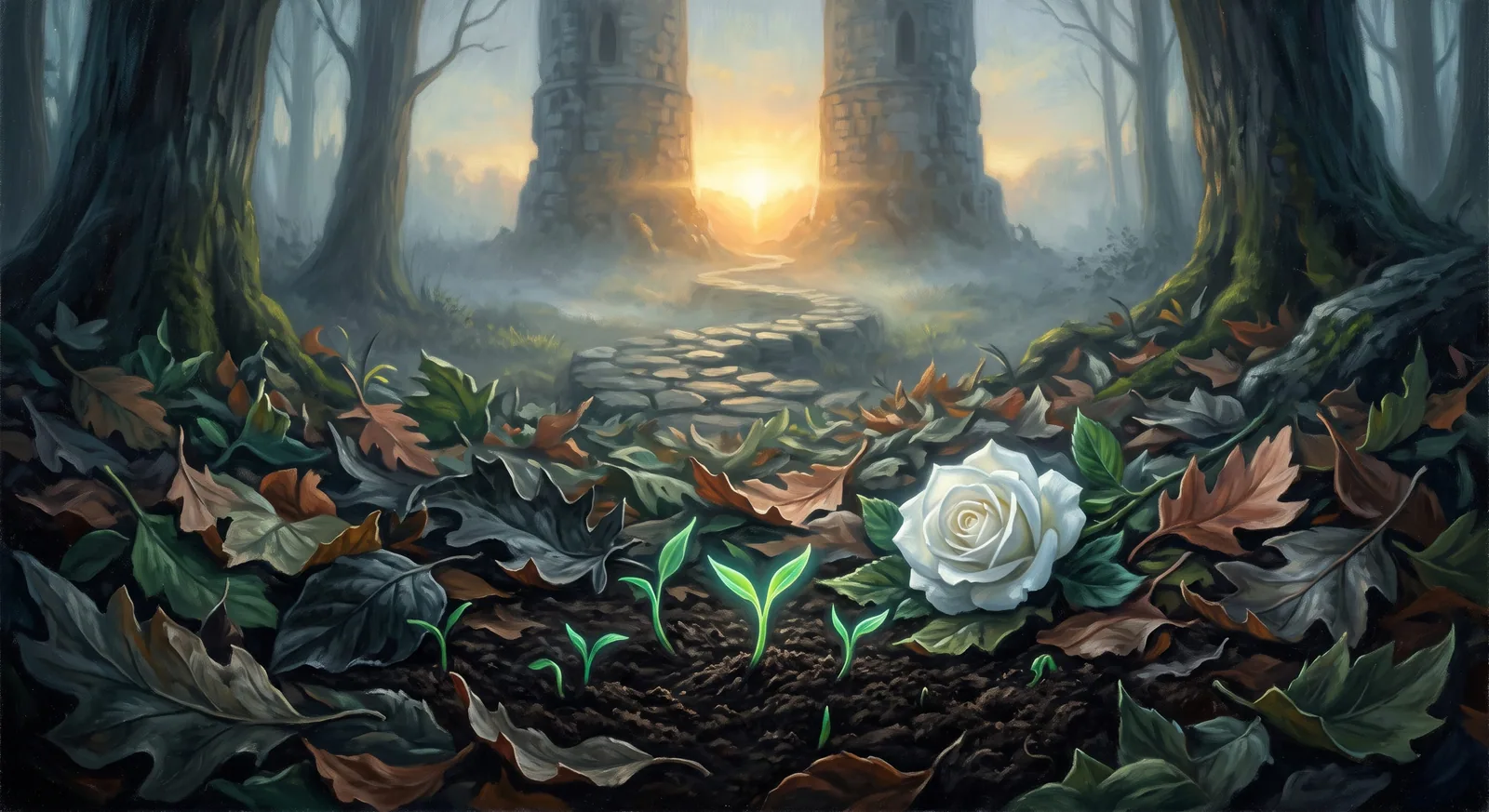
A leaf falls because its season is over. The tree does not consider the fallen leaf a failure. The leaf becomes part of the earth, and eventually its nutrients support new growth.
The same principle can exist in our lives.
An ending can become wisdom.
Heartbreak can become self-knowledge.
Failure can become clarity.
A closed door can create space for a path you could not see before.
The Death card reminds us that transformation often begins with release.
The Spiritual Meaning of Death in Tarot
At its deepest level, Death is a card about surrender.
Not giving up.
Surrendering what can no longer continue.
There is a difference.
Giving up says:
"Nothing can change."
Surrender says:
"I accept that this chapter has changed, and I am willing to discover what comes next."
That distinction is at the heart of the Death archetype.
Sometimes we hold onto something because we are afraid of who we will become without it.
We may know a relationship has changed, but still cling to the person we remember.
We may know a career no longer fulfills us, but continue because it once gave us an identity.
We may know an old emotional pattern hurts us, but keep returning to it because it feels familiar.
Death gently asks:
Who would you become if you stopped trying to resurrect what has already ended?
Death Tarot Card and Transformation
Transformation is rarely comfortable.
We often imagine transformation as a beautiful moment of awakening, a sudden realization followed by immediate clarity.
Real transformation is usually quieter.
There can be a period when you don't know who you are anymore.
The old version of you is disappearing, but the new version has not fully arrived.
This is the liminal space represented by Death.
You are between identities.
Between chapters.
Between what was and what will be.
Spiritually, this can feel like emptiness.
But emptiness is not always absence.
Sometimes it is space.
And space is where something new can begin.
The Death Card and Grief
One of the most important lessons of the Death card is that transformation does not eliminate grief.
Sometimes we resist endings because we believe that accepting them means admitting that something never mattered.
It is the opposite.
You can honor what something meant to you and still let it go.
You can love someone and recognize that the relationship has reached its natural ending.
You can appreciate who you once were without continuing to live as that person.
You can be grateful for a chapter while accepting that you are ready for another one.
Grief is not evidence that you made the wrong choice.
Sometimes grief is simply evidence that something mattered.
The Death card gives you permission to mourn before you move forward.
Death Tarot Card Symbolism
The traditional Rider-Waite-Smith Death card contains some of the most powerful imagery in tarot.
The Skeleton
The skeleton reminds us that beneath our roles, identities, possessions, and social positions, we are all part of the same human cycle.
The skeleton has nothing left to hide behind.
Spiritually, it represents the stripping away of what is superficial so that something more authentic can emerge.
The Black Armor
The dark armor reflects the mysterious and unavoidable nature of transformation.
There are moments in life when we cannot negotiate with change.
We cannot make a season last forever.
We cannot return to who we were simply because it feels familiar.
The armor reminds us that some transitions must be experienced rather than controlled.
The White Rose
The white rose carried on the banner is one of the card's most beautiful symbols.
It introduces purity, openness, beauty, and renewal into an image otherwise dominated by darkness.
The message is profound:
Even in the presence of endings, something beautiful remains.
The rose suggests that transformation does not destroy everything.
It reveals what is still alive.
The Fallen King
The fallen king represents the illusion that power can protect us from change.
Status, success, money, recognition, and control cannot stop the cycles of life.
Death treats everyone equally.
Spiritually, this can be a reminder to release the need to control every outcome.
The Child
The child responds to the Death figure differently from the adults around him.
There is a sense of openness and curiosity.
The child does not yet carry the same expectations about how life is supposed to unfold.
This can represent a spiritual invitation:
Meet change with curiosity instead of assuming it must be something to fear.
The Rising Sun
Perhaps the most hopeful image in the card is the golden sun appearing between the distant towers.
The sun is rising.
This matters.
Death contains its own promise of renewal.
The ending is not the entire story.
There is another horizon beyond it.
Death Tarot Card: Endings That Create Space
One of the most helpful ways to understand Death is to ask:
What is this ending making room for?
When we are emotionally attached to something, we tend to focus on what is disappearing.
Death asks you to look at the space being created.
If an old relationship pattern ends, perhaps healthier love becomes possible.
If an identity falls away, perhaps you can finally discover who you are without performing for others.
If a career chapter ends, perhaps you can follow a calling that previously felt too risky.
If an old belief dissolves, perhaps you become available to a deeper truth.
The Death card is not promising that the next chapter will be easy.
It is reminding you that the next chapter cannot fully begin while you are still living inside the previous one.
Death Tarot Card in Love and Relationships
In a love reading, the Death card can initially feel frightening.
But it does not automatically mean a breakup.
Its meaning depends on the question, the surrounding cards, and the emotional reality of the relationship.
Death often points to transformation within the relationship.
An old dynamic may need to end.
A pattern of jealousy may need to be released.
Emotional dependency may be coming to an end.
A relationship may be moving into a completely different stage.
Sometimes, however, Death can indicate that the relationship itself has reached the end of its natural cycle.
The important question is not simply:
"Are we going to break up?"
A deeper question is:
"What part of this relationship can no longer continue as it has?"
That question allows the card to speak with much greater clarity.
If You Are Single
Death can suggest that you are leaving behind an old understanding of love.
Perhaps you are no longer willing to repeat the same patterns.
Perhaps you are releasing an attachment to someone from your past.
Perhaps the version of yourself that accepted emotionally unavailable relationships is beginning to disappear.
Before new love arrives, something old may need to be released.
Death Tarot Card in a Career Reading
In career readings, Death often points toward professional transformation.
This could mean:
- Leaving an unfulfilling role
- Changing career direction
- Ending an outdated professional identity
- Moving away from a workplace that no longer fits
- Closing a project or business chapter
- Redefining what success means to you
It does not necessarily mean losing your job.
Sometimes the Death card appears when your relationship with work needs to change rather than the work itself.
Ask yourself:
What am I continuing because it is meaningful, and what am I continuing simply because I am afraid to let it end?
Death Tarot Card in a Yes or No Reading
The Death card is not traditionally a simple yes-or-no card.
Its message is more nuanced.
If you are asking whether something should continue exactly as it is, Death often suggests no.
But if you are asking whether transformation is possible, Death can represent a powerful yes.
Something may be ending, but that does not mean everything is lost.
It means the current form may no longer be sustainable.
Death Tarot Card Reversed
When Death appears reversed, the theme of resistance often becomes stronger.
You may know that something needs to end but continue holding onto it.
You might be afraid of the unknown.
You might be attached to the past.
You may keep hoping that something will return to the way it once was.
Death reversed can ask:
What are you keeping alive because you are afraid to grieve it?
This does not mean you should make a dramatic decision immediately.
Instead, it invites honest reflection.
What feels finished?
What are you resisting?
What would happen if you stopped forcing something to remain unchanged?
Sometimes the first step toward transformation is simply admitting that you know a change is coming.
The Death Tarot Card and Shadow Work
Death can be a powerful card for shadow work because endings often reveal what we are most afraid to release.
Ask yourself:
- What am I afraid I will lose?
- Who would I be without this identity?
- What familiar pain am I choosing over unfamiliar freedom?
- What part of my past am I trying to bring into my future?
- What am I holding onto because it is familiar rather than healthy?
- What lesson can I carry forward even if I leave the situation behind?
These questions can reveal the deeper emotional story beneath an ending.
The goal is not to destroy the past.
It is to stop asking the past to become your future.
A Four-Card Death Tarot Spread for Transformation
If the Death card appears in your reading, try this four-card spread to explore what is ending and what is beginning.
Card 1: What Is Ending?
What has completed its natural cycle in my life?
This card reveals the chapter, pattern, belief, or attachment that may be ready to be released.
Card 2: What Am I Holding Onto?
What makes it difficult for me to let this go?
This card can reveal fear, nostalgia, attachment, guilt, or an identity you are not yet ready to surrender.
Card 3: What Is Transforming Within Me?
What am I becoming through this experience?
Look beyond the external circumstances.
Something inside you may already be changing.
Card 4: What Is Waiting to Emerge?
What becomes possible when I release what has completed its journey?
This is not necessarily a prediction of the future.
Instead, see it as an invitation to recognize the possibility created by your willingness to let go.
A Simple Ritual for Working With the Death Card
You do not need an elaborate ritual to connect with the energy of Death.
Find a quiet place and write down one thing you know you are ready to release.
It might be:
- An old belief
- A relationship pattern
- A version of yourself
- A regret
- A fear
- A story you keep repeating
- Something you have outgrown
Then place your hand over the page and acknowledge what that chapter gave you.
You might say:
"I honor what this chapter taught me. I release what no longer belongs to me. I trust myself to walk into what comes next."
You do not have to know what comes next.
That is part of the spiritual lesson.
Sometimes faith means taking the next step before you can see the entire path.
What the Death Tarot Card Wants You to Remember
The Death card is not here to frighten you.
It appears when something is asking to be released.
Sometimes that release is painful.
Sometimes it is peaceful.
Sometimes you know immediately what needs to go.
Sometimes you only understand months later.
But the spiritual invitation remains the same:
Let what is finished be finished.
You do not need to keep reopening a door simply because you once loved what was behind it.
You do not need to remain loyal to an identity that no longer feels like you.
You do not need to turn every ending into a failure.
Some chapters are meant to end.
Some versions of you are meant to disappear.
And some endings are the quiet beginning of becoming someone you could not have imagined before.
The Death card reminds us that life is not a straight line.
It moves in cycles.
Release.
Rest.
Renewal.
Growth.
And then, eventually, another transformation.
The darkness is not necessarily where the story ends.
Sometimes it is where the next version of you begins to take root.
Key Takeaways
- Death is about transformation, not automatically physical death.
- The card represents endings, release, rebirth, and renewal.
- Grief can be part of healthy transformation.
- Death asks you to release what has completed its purpose.
- In love readings, it can describe the transformation or ending of a relationship dynamic.
- Death reversed can point to resistance, attachment, or fear of change.
- The rising sun in the traditional card reminds us that every ending can contain the possibility of renewal.
- You do not have to know what comes next to honor what is ending now.
Pull a tarot card
Hold a question in mind and draw one card from the full 78-card deck, upright or reversed.
Frequently asked questions
Does the Death tarot card mean someone will die?
What does the Death card mean spiritually?
Is the Death tarot card a bad card?
What does Death mean in a love tarot reading?
What does Death reversed mean in tarot?
What is the difference between Death and the Tower in tarot?
What should I do if I keep drawing the Death card?
Keep reading
Across Psychic Pulse
The same themes, seen through another practice.