How to Read the Three-Card Tarot Spread
The past, present, future spread is one of tarot's simplest layouts. Here's how to read the cards as one story instead of three separate predictions.
In this article (5)
The three-card tarot spread is one of the simplest ways to begin reading tarot—and one of the easiest to overthink.
You may already know the classic past, present, future tarot spread. Three cards, three positions, one story.
But the real skill isn't memorizing what every card means. It's learning how to see the relationship between the cards without forcing them to tell you what you want to hear.
A good three-card reading should leave you with clarity, not more anxiety.
Here's the simple approach our tarot editor actually uses.
Before You Shuffle: Write Down Your Question
Before you touch the deck, write your question down.
Not because the cards need you to write it. They don't.
Write it because you will probably change the question halfway through the reading if it stays in your head.
You might begin with:
"What do I need to know about my relationship?"
Then you pull a difficult card, and suddenly you're asking:
"Does my partner still love me?"
Then another card appears, and the question quietly becomes:
"Are we going to break up?"
By the end, you're no longer reading one question. You're trying to make the cards answer five different ones.
Writing your question down gives the reading a boundary.
It also makes the reading more honest. You can come back to the exact question afterward and ask: Did the cards actually speak to this, or did I make them speak to something else?
For questions about relationships, work, decisions, or personal growth, try keeping your question open rather than demanding a prediction.
Instead of:
"Will I get the job?"
Try:
"What should I understand about my situation at work?"
Instead of:
"Will we stay together?"
Try:
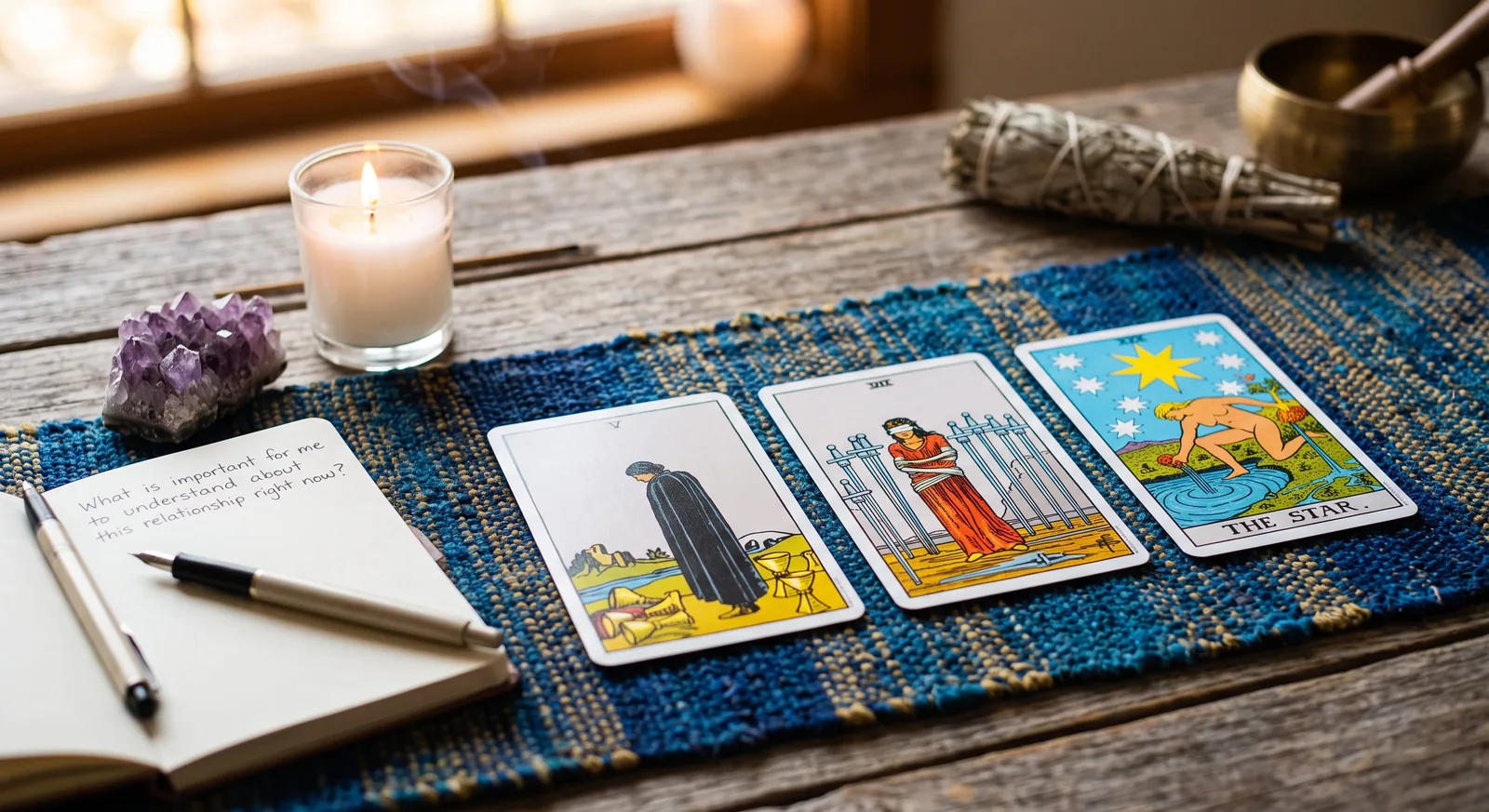
"What is important for me to understand about this relationship right now?"
The second type of question gives the cards room to offer reflection rather than forcing a yes-or-no answer.
The Past Card: What Is Still Influencing You?
The first card in a past, present, future tarot spread isn't necessarily about something that happened years ago.
Think of it as the part of your past that is still doing work in your present.
It could be a relationship you haven't emotionally finished processing.
It could be a habit you learned when you were young.
It could be an old disappointment that still shapes how you approach new opportunities.
It could even be a promise you made to yourself at nineteen and have been quietly carrying ever since.
The important question isn't simply:
"What happened in the past?"
Ask instead:
"What from my past is still influencing the situation I'm asking about?"
That small change makes the card much more useful.
For example, if you pull The Five of Cups, you don't have to interpret it as "something bad happened."
Perhaps the more relevant message is that disappointment is still influencing the way you're looking at what's available to you now.
If you pull The Emperor, the influence might be an old lesson about control, responsibility, or authority.
If you pull The Fool, perhaps the past influence is an earlier willingness—or reluctance—to take a leap.
The past card is not a history lesson.
It is a live influence.
The Present Card: What Is Happening Now?
The middle card represents the present.
This sounds obvious, but it's where many tarot beginners get stuck.
The present is where the anxiety lives.
You're worried about what is happening right now, so you stare at the middle card and keep pulling more cards to explain it.
Resist that temptation.
Give the present card one clear sentence.
That's enough.
Ask:
"What is the central energy of this situation right now?"
Then answer in one sentence.
For example:
"I'm trying to make a decision while feeling afraid of making the wrong one."
Or:
"I'm moving forward, but I'm still carrying disappointment from what happened before."
Or:
"I have more options than I am currently allowing myself to see."
Then move on.
The present card doesn't have to explain everything.
In fact, in a three-card spread, the middle card may be the least informative card of the three. It tells you where you are standing, but the cards around it can reveal why you are there and where the energy appears to be moving.
Don't turn one card into an entire psychological diagnosis.
The Future Card: Where the Energy Is Moving
The third card is traditionally called the future.
This is where it's helpful to be careful with tarot.
A future card does not have to mean "this is definitely going to happen."
Tarot can be much more useful when you read the future position as:
"If the current pattern continues, where is this energy tending to go?"
That distinction matters.
It leaves room for choice.
If you pull The Tower, you don't have to conclude that disaster is coming.
You might instead ask what structure in your life is becoming impossible to maintain.
If you pull The Star, you don't have to treat it as a guarantee that everything will work out perfectly.
You might see it as an invitation toward hope, healing, honesty, or renewed trust.
The future card shows a direction.
It doesn't take your steering wheel.
Your decisions, circumstances, relationships, and actions still matter.
How to Read the Three Cards Together
This is the part that makes a three-card tarot reading actually work.
Don't read the cards as three separate mini-readings.
Read the line they create.
The spread isn't really:
Card 1 + Card 2 + Card 3
It's:
Card 1 → Card 2 → Card 3
The cards are having a conversation.
Look for movement.
Does the energy become lighter?
Does it become more intense?
Does the final card resolve something introduced by the first?
Does the future card contradict what you expected?
Try reading the spread from left to right as though it were a sentence.
Then say that sentence out loud.
For example:
Five of Cups → Eight of Swords → The Star
Instead of interpreting each card separately:
"The Five of Cups means sadness. The Eight of Swords means feeling trapped. The Star means hope."
Try connecting them:
"Past disappointment has made me feel more trapped than I actually am, and the way forward begins when I allow myself to believe something different is possible."
That's a reading.
The individual card meanings are still important, but they are ingredients rather than the finished meal.
Look for Repetition
Before reaching for a tarot guidebook, look at the three cards visually.
Do you notice:
- Lots of people?
- Lots of movement?
- Repeated numbers?
- Several cards from the same suit?
- Multiple Major Arcana cards?
- A progression from darkness to light?
- Similar symbols or themes?
Patterns often tell you more than individual definitions.
If all three cards belong to the Cups suit, emotions and relationships may be particularly relevant.
If several Swords appear, the reading may be emphasizing thoughts, communication, conflict, or mental pressure.
If Pentacles dominate, practical matters, money, work, health routines, or stability may deserve attention.
If Wands dominate, action, desire, creativity, ambition, or momentum may be central.
And if you pull several Major Arcana cards, you might treat the reading as pointing toward a larger personal lesson rather than an ordinary day-to-day concern.
You don't need to force any of these patterns.
Simply notice them.
Don't Pull Clarifying Cards Too Quickly
One of the fastest ways to turn a three-card reading into a twenty-card reading is to dislike an answer.
You pull a card.
You don't understand it.
So you pull another.
Then another.
Then another because the third card somehow made the second card confusing.
Suddenly, the original question has disappeared beneath a pile of cardboard.
Before pulling a clarifying card, sit with the original three.
Ask yourself:
"What am I actually confused about?"
Sometimes the confusion isn't in the cards.
It's in us.
We want certainty, while tarot is giving us something subtler: a perspective.
If you do pull a clarifier, give it a specific job.
Don't ask:
"What does this mean?"
Ask:
"What aspect of this card am I missing?"
That keeps the reading focused.
What If the Cards Don't Make Sense?
Sometimes they won't.
That's normal.
Not every spread produces an immediate revelation.
If the cards seem disconnected, don't immediately assume you've done something wrong.
Start with the simplest interpretation.
Look at the three cards as a sequence.
Then ask:
What is the common theme?
You might also return to your written question.
This is important because the temptation is to make the cards more complicated when they don't make sense.
Usually, the opposite helps.
Go back to the basics.
What do I see?
What do I feel?
What changes from the first card to the third?
What story does the sequence suggest?
You don't need to find the "perfect" interpretation.
You are looking for the interpretation that is honest, useful, and connected to your actual question.
The Simplest Three-Card Tarot Method
If you want a repeatable method, use this:
1. Write your question
Keep it specific and open-ended.
2. Shuffle and pull three cards
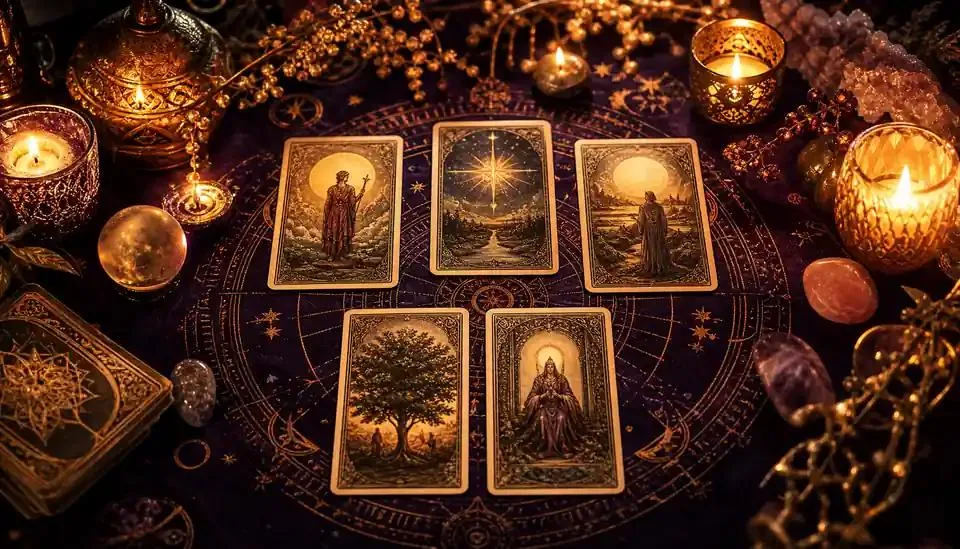
Place them from left to right.
3. Read the first card
Ask:
What from the past is still influencing me?
4. Read the second card
Ask:
What is the central energy right now?
Give it one sentence.
5. Read the third card
Ask:
Where is this energy tending to go if nothing changes?
6. Look at all three
Ask:
What story do these cards tell together?
7. Say the reading out loud
If the sentence sounds natural and grounded, you're probably onto something.
If it sounds like you're trying to make every symbol fit, you've probably over-read it.
The Three-Card Spread Is a Conversation, Not a Verdict
The beauty of a simple tarot spread is that you don't need twenty cards to have a meaningful reading.
Three can be enough.
The past shows you what you're carrying.
The present shows you where you're standing.
The future shows you where the current energy may be heading.
But the real message lives between them.
Tarot doesn't have to tell you exactly what will happen next.
Sometimes its most valuable role is simply to help you see what you already know from a different angle.
So write down your question. Pull three cards. Look at the whole line.
And before you pull another card, ask yourself one final question:
If I stopped trying to make the cards predict my future, what are they helping me understand about my present?
That may be the reading you were looking for.
Pull a tarot card
Hold a question in mind and draw one card from the full 78-card deck, upright or reversed.
Frequently asked questions
What is a three-card tarot spread?
How do you read a three-card tarot spread?
What does the past card mean in tarot?
What does the present card mean in tarot?
Does the future tarot card predict what will happen?
Should I pull a clarifying card?
Can I do a three-card tarot reading for myself?
What if my three tarot cards don't make sense together?
Keep reading
Across Psychic Pulse
The same themes, seen through another practice.