
Looking Into Mirrors in Dreams: Spiritual Meaning, Distorted Reflections, and the Shadow Self
A mirror in a dream can be a powerful invitation to look within. Discover what distorted reflections, unfamiliar faces, broken glass, and missing reflections may reveal about your emotions, identity, and spiritual journey.
In this article (12)
What if the reflection you see in a dream is inviting you to meet the parts of yourself you've forgotten, hidden, or outgrown?
There is something deeply mysterious about looking into a mirror in a dream.
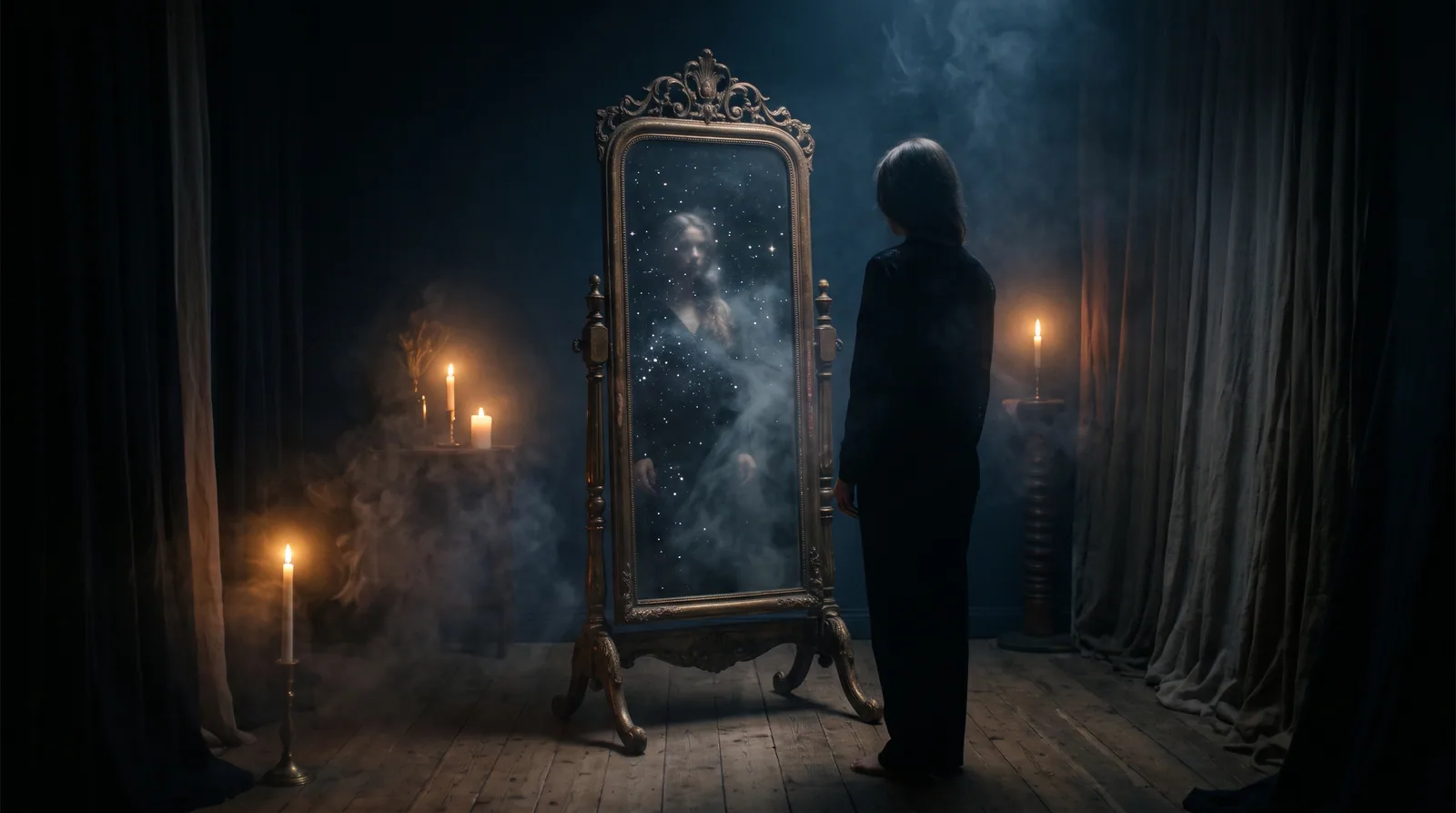
You approach the glass expecting to see your familiar face. Instead, your reflection looks older, unfamiliar, strangely beautiful, or frighteningly different. Perhaps the person staring back at you doesn't move when you move. Perhaps the mirror is broken, or perhaps you look into it and discover that your reflection has disappeared entirely.
You wake up carrying the feeling long after the dream has faded.
Dreams involving mirrors can feel unusually personal because they bring us face-to-face with an image of ourselves. They touch something intimate: the difference between how we appear to the world and how we feel deep inside.
The spiritual meaning of looking into mirrors in dreams often centers on self-discovery, inner truth, identity, and the parts of ourselves asking to be acknowledged. A familiar reflection may bring a sense of recognition, while a distorted or unfamiliar face may invite you to explore feelings, fears, or changes you haven't fully understood.
There is no single interpretation that applies to everyone. The meaning of your dream depends on the reflection you saw, the emotions you experienced, and what is happening in your waking life.
Rather than treating the dream as a warning or a prediction, consider it an invitation to listen more closely to yourself.
The Spiritual Meaning of Mirrors in Dreams
Throughout spiritual traditions and folklore, mirrors have been associated with truth, wisdom, mystery, and the boundary between what is visible and what remains hidden.
A mirror shows you an image, but it cannot tell you the whole story of the person standing before it. In dreams, this quality becomes even more meaningful. The reflection may look familiar, or it may reveal something you don't immediately recognize.
Spiritually, a mirror in a dream can symbolize several things.
A call to look within
You may be spending so much time responding to other people's expectations that you've lost touch with your own needs. A dream mirror can invite you to pause and ask whether the life you're living still feels true to you.
Perhaps you've become the dependable one, the peacemaker, the achiever, or the person who never asks for help. These roles may be meaningful, but they don't have to contain your entire identity.
Your dream may be encouraging you to remember the person beneath those roles.
A moment of inner truth
Sometimes, we already know what we need to acknowledge. We simply aren't ready to say it aloud.
A mirror dream may appear when a feeling, desire, or truth has been quietly waiting for your attention. It might concern a relationship, a boundary you've struggled to maintain, a dream you've abandoned, or a version of yourself you've outgrown.
The reflection doesn't need to reveal a literal secret. Its meaning may lie in the emotion it awakens.
A season of personal transformation
Your reflection can also represent your current sense of identity.
When your life is changing, the person you used to be may no longer feel entirely familiar. You might be moving away from an old relationship, changing careers, healing from a difficult chapter, or beginning to question beliefs you've carried for years.
In these moments, a strange reflection can symbolize the unfamiliar feeling of becoming someone new.
A mirror dream may be less about discovering a hidden version of yourself and more about learning to recognize who you are becoming.
What Does It Mean to See Your Reflection in a Dream?
Seeing your reflection in a dream often brings attention to self-image, authenticity, and the relationship you have with yourself.
The most important clue is how you feel when you look into the glass.
Seeing your normal reflection
If your reflection looks familiar and you feel calm, the dream may reflect a period of self-acceptance or growing inner stability.
You may be becoming more comfortable with who you are, including the parts you once tried to change to gain approval.
If you feel uneasy despite seeing an ordinary face, consider whether you're avoiding a feeling that is difficult to acknowledge. Sometimes, the familiar image is not the central message. Your emotional response is.
Seeing a beautiful or radiant reflection
A glowing, peaceful, or unusually beautiful reflection may symbolize renewed confidence, hope, or a deeper appreciation of your own worth.
Perhaps you're beginning to recognize qualities in yourself that you once overlooked. You may be healing from criticism, learning to trust your intuition, or allowing yourself to receive love without feeling you must earn it.
You don't need to interpret this as proof of a supernatural transformation. It can be a meaningful reminder that your relationship with yourself is changing.
Feeling afraid of your own reflection
Fear in a mirror dream can point toward vulnerability, uncertainty, or discomfort with something you're beginning to recognize about yourself.
Perhaps you're afraid of disappointing someone. Maybe you're confronting anger you've always tried to suppress, or you're questioning an identity that once gave you security.
The fear doesn't mean that something bad is about to happen.
Instead, ask yourself what feels difficult to face right now. Sometimes, the things we avoid are not dangerous; they are simply unfamiliar.
What Does a Distorted Face in a Dream Mean?
Seeing a distorted face in a dream can be unsettling. Your features may appear stretched, melted, aged, shadowed, or almost unrecognizable.
From a spiritual perspective, this image can symbolize a changing self-image, emotional overwhelm, or the feeling that your outer life no longer reflects your inner experience.
Consider whether you've been trying to maintain an image of yourself that has become exhausting.
Perhaps everyone sees you as strong, even when you feel fragile. Maybe you've spent years trying to be perfect, agreeable, successful, or endlessly available to others.
Over time, the distance between the person you present to the world and the person you feel yourself to be can become uncomfortable.
A distorted reflection may offer a symbolic way to explore that tension.
It may also appear during periods of stress, grief, uncertainty, or significant change. Dreams are personal experiences, not fixed diagnoses, and a strange image alone cannot tell you exactly what you're feeling.
Instead of asking, "What's wrong with my face?" try asking:
- Where in my life do I feel unlike myself?
- Am I carrying expectations that no longer fit?
- What part of me needs rest, honesty, or compassion?
- Where am I afraid to let others see the real me?
The goal isn't to correct the reflection. It's to understand what the image brings to the surface.
Seeing a Stranger or Doppelgänger in a Dream Mirror
One of the most memorable mirror dreams occurs when you look into the glass and see someone else staring back.
The stranger may resemble you, feel familiar without being recognizable, or appear to have a personality of their own. Sometimes, the reflection smiles when you're frightened or moves independently of your actions.
Such dreams can feel eerie, but they don't automatically signify danger or a supernatural presence.
One useful way to understand them is through the idea of the shadow self.
What is the shadow self?
The shadow self is a concept associated with the Swiss psychiatrist Carl Jung. It refers broadly to aspects of ourselves that we struggle to recognize, accept, or express.
These aspects aren't necessarily negative.
Your shadow might include anger you've been taught to hide, ambition you've been afraid to admit, creativity you've neglected, or a desire for independence you've kept quiet to preserve harmony.
It can also contain qualities you admire in others but find difficult to claim for yourself, such as confidence, freedom, courage, or emotional openness.
When a stranger appears in your dream reflection, you might explore whether the figure represents a quality you have pushed aside.
Ask yourself what stands out about the stranger. Are they powerful, cold, playful, sad, rebellious, or peaceful? What do they seem to possess that you feel disconnected from?
The answers may reveal more about the dream's personal meaning than the stranger's appearance.
Why does the reflection move independently?
A reflection that refuses to follow your movements can represent a feeling that something within you is difficult to control or understand.
You may be changing in ways your conscious mind hasn't fully caught up with. You might also be experiencing conflicting desires: wanting closeness while needing independence, seeking security while longing for adventure, or trying to please others while yearning to speak honestly.
The independent reflection can symbolize these inner contradictions.
You don't need to fear the figure or assume it has an intention of its own outside the dream. Treat it as an opportunity to explore what feels unfamiliar within you.
Sometimes, what initially appears frightening is simply a part of yourself you haven't yet learned to understand.
What Does a Broken Mirror Mean in a Dream?
A broken mirror in a dream can symbolize change, emotional disruption, a fractured self-image, or the end of an old way of seeing yourself.
Perhaps a relationship has changed how you understand love. Maybe a disappointment has challenged a belief you've held for years. Or perhaps you're realizing that the life you carefully built no longer reflects your deepest values.
Broken glass can make these transitions feel dramatic, but the dream doesn't have to be a bad omen.
In some interpretations, a broken mirror represents the possibility of seeing yourself differently. When an old image falls apart, you may begin to discover parts of your identity that were hidden behind it.
Consider what has recently changed in your life.
Are you grieving who you used to be? Are you trying to preserve a version of yourself that no longer feels authentic? Are you afraid of what might happen if you stop meeting other people's expectations?
You don't have to rebuild your old reflection immediately.
Sometimes, personal growth begins with admitting that the old picture no longer fits.
If the broken mirror leaves you feeling peaceful or relieved, that emotion may suggest a sense of release. If it leaves you grieving or afraid, you may need time to process what is changing.
A broken mirror dream is not a prediction of misfortune. Its meaning is best explored through your personal circumstances and the feelings the dream leaves behind.
What Does It Mean to See No Reflection in a Dream?
Looking into a mirror and seeing nothing can be one of the strangest dream experiences.
You may see an empty surface, a dark space, a blurred outline, or a mirror that reflects the room but not your body.
Spiritually, a missing reflection can symbolize disconnection, uncertainty about identity, emotional exhaustion, or a longing to feel seen.
Perhaps you've been caring for everyone around you while neglecting your own needs. You may have become so accustomed to adapting to others that you struggle to recognize what you genuinely want.
Or you may be moving through a transition in which your old identity has faded before a new one has fully emerged.
These experiences can leave you feeling invisible, even to yourself.
If this interpretation resonates, gently consider where you may have been abandoning your own needs to maintain peace or gain approval.
You might ask:
- When was the last time I did something simply because it mattered to me?
- Which feelings have I been setting aside?
- Do I feel understood by the people closest to me?
- What would help me feel more present in my own life?
A missing reflection doesn't mean you've lost your soul or that something is spiritually wrong with you. It can be a powerful image through which to explore belonging, identity, and self-connection.
Looking Into a Mirror in a Lucid Dream
A lucid dream occurs when you become aware that you're dreaming while the dream is still happening.
Because lucid dreamers sometimes choose to examine their surroundings, mirrors can become particularly intriguing. You might deliberately look into one to see what happens, only to discover an unfamiliar face, shifting features, or an unexpected scene.
There are many stories about mirrors in lucid dreams, including claims that they are dangerous or that looking into them opens a doorway to another realm. These stories are part of dream folklore, not established evidence that dream mirrors are supernatural portals.
If you encounter a mirror in a lucid dream, you can approach it with curiosity rather than fear.
Notice what you see and how you feel. If the image becomes uncomfortable, you can look away, focus on another part of the dream, or remind yourself that you're experiencing a dream.
You might also ask a gentle question, such as, "What does this image remind me of?" or "What feeling is asking for my attention?"
You don't have to force an answer. Sometimes, simply observing the dream is enough.
The most meaningful insight may come later, when you reflect on the experience in the context of your waking life.
How to Understand the Spiritual Message of Your Mirror Dream
There is no universal dream dictionary that can determine the exact meaning of every reflection. Symbols gain meaning through personal experience, culture, emotion, and the circumstances of your life.
Instead of searching for one definitive answer, try this gentle reflection practice.
1. Remember the feeling before the image
Before interpreting the mirror itself, recall the emotion you experienced.
Were you afraid, curious, comforted, ashamed, surprised, or peaceful?
A distorted reflection accompanied by curiosity may feel very different from the same image accompanied by terror. Your emotions offer an important clue about what the dream means to you.
2. Describe what you saw without judging it
Write down the details you remember.
Was the mirror old or new? Was the glass clear, cracked, dark, or misty? Did you recognize the person looking back at you? Did the reflection appear calm or threatening?
Try to describe the dream before explaining it. This helps you notice the experience without immediately imposing a frightening or overly dramatic interpretation.
3. Connect the dream to your waking life
Think about what has been happening recently.
Are you beginning a new chapter? Have you been struggling with a relationship, a personal boundary, or a difficult decision? Are you feeling disconnected from someone you love, or from the person you used to be?
Look for emotional connections rather than assuming that every dream detail has a fixed symbolic meaning.
4. Ask what the reflection might be inviting you to notice
Imagine that the reflection is a symbol of a feeling or part of yourself that deserves attention.
What might it represent?
Perhaps the stranger reflects your desire for freedom. Perhaps the broken glass reminds you of an identity you've outgrown. Perhaps the missing reflection echoes a longing to feel acknowledged.
Allow several possibilities to exist. You don't have to choose the first explanation that comes to mind.
5. Turn the insight into one gentle action
Dream interpretation becomes more useful when it helps you live with greater awareness.
If your dream reminds you that you're exhausted, give yourself permission to rest. If it brings attention to an unspoken feeling, consider writing it down or discussing it with someone you trust. If it reminds you of a neglected passion, make a little room for it.
You don't need to make a dramatic life change because of a dream.
Sometimes, the most meaningful response is a small act of honesty, kindness, or self-respect.
A Gentle Mirror Ritual for Self-Reflection
If your dream continues to stay with you, you can use a simple morning ritual to explore its emotional meaning.
This practice is not intended to reveal hidden supernatural truths or force a message from the unconscious. It is simply a way to create a quiet moment of connection with yourself.
Step 1: Create a peaceful space.
Find a comfortable place with soft natural light. Sit quietly for a few moments and allow your breathing to settle.
Step 2: Meet your own gaze gently.
If you feel comfortable, look at your reflection in a mirror. There is no need to stare intensely or continue if it feels uncomfortable. You can also close your eyes and remember the dream instead.
Step 3: Offer yourself compassion.
Silently say:
I am willing to see myself with honesty and kindness. I do not need to understand everything today. I can meet the parts of myself I have neglected with patience.
Step 4: Write a few words about the dream.
Complete these three sentences in a journal:
- The reflection I remember most clearly is...
- The feeling I am still carrying is...
- One thing I may need to acknowledge in my waking life is...
Let your answers be simple. You don't need to force a revelation or treat every thought as a message.
Step 5: Choose one grounded intention.
Decide on one small action that supports your well-being. It might be setting a boundary, taking a break, expressing a feeling, reconnecting with a meaningful activity, or allowing yourself to ask for help.
Close the ritual by reminding yourself that self-discovery is a gradual process. You are allowed to learn about yourself without judging everything you find.
When Mirror Dreams Keep Returning
Recurring mirror dreams can be especially memorable. If you repeatedly see distorted faces, unfamiliar reflections, or mirrors that refuse to show you anything, consider whether the dreams coincide with a recurring emotion or life situation.
Perhaps you keep questioning your identity. Maybe you're navigating a relationship that leaves you uncertain about yourself, or you're struggling to reconcile who you are with who others expect you to be.
The repetition may provide an opportunity to reflect on what continues to occupy your attention.
However, recurring dreams don't always have a clear symbolic message. Stress, disrupted sleep, strong emotions, and ordinary dream variation can all influence what you experience at night.
If a dream repeatedly causes significant distress or interferes with your sleep, talking with a qualified mental health professional may help you explore the experience and improve your sense of safety and rest.
You do not need to interpret every dream perfectly. Curiosity is enough.
The Deeper Invitation: Learning to Recognize Yourself
Looking into mirrors in dreams can bring you into contact with some of life's most personal questions.
Who are you when no one is watching? Which parts of yourself have you learned to hide? Are you living according to your own values, or trying to maintain an image that no longer feels right?
These questions can be uncomfortable, but they can also open the door to greater self-understanding.
In the language of spiritual reflection, the mirror becomes a symbol of the meeting between your outer identity and your inner world. In Jungian thought, it can offer a useful way to explore the shadow: the qualities, feelings, and possibilities you may struggle to acknowledge.
Neither perspective requires you to fear what you see.
You don't have to become a perfect version of yourself, eliminate every shadow, or uncover one final truth. You only need the willingness to meet yourself a little more honestly than before.
Perhaps the unfamiliar face in your dream represents a part of you ready to be heard. Perhaps the broken mirror reflects a chapter that is ending. Or perhaps the dream simply leaves you with a feeling worth exploring.
Let the image remain a question rather than a prophecy.
And when you return to the mirror of your waking life, remember that you are more than the face you present to the world, more than the roles you fulfill, and more than the fears you carry.
You are a person still becoming.
A Parting Blessing
May you find the courage to look within without turning against yourself.
May the parts of you that have felt hidden or forgotten find room to breathe. May you release the identities you've outgrown without losing tenderness for the person you once were.
And when the dream mirror shows you something unfamiliar, may you meet it with curiosity rather than fear.
You do not have to understand every reflection.
Sometimes, the beginning of healing is simply the willingness to look, to listen, and to offer yourself the same compassion you so freely give to others.
Key Takeaways
- Mirrors in dreams often symbolize self-reflection: They can invite you to explore identity, authenticity, and your relationship with yourself.
- Distorted reflections may reflect inner uncertainty: They can provide a symbolic way to explore stress, changing self-image, or the pressure to meet expectations.
- Strangers may represent unfamiliar parts of yourself: The Jungian concept of the shadow offers one useful lens for exploring qualities you have overlooked or suppressed.
- Broken mirrors can symbolize change: They may reflect an old identity or belief system giving way to a new perspective, rather than predicting bad luck.
- A missing reflection may evoke disconnection: Consider whether you feel unseen, depleted, or distant from your own needs.
- Dreams are personal, not universal prophecies: Your emotions, experiences, and current circumstances matter more than a fixed dream dictionary.
- Gentle reflection is more useful than fear: Journaling, quiet contemplation, and small acts of self-care can help you explore a dream's meaning in everyday life.
Frequently asked questions
What does looking into a mirror in a dream mean spiritually?
What does it mean when you see a distorted face in a dream?
Why do I see a stranger when I look into a mirror in my dream?
What does a broken mirror mean in a dream?
What does it mean when you have no reflection in a dream?
Is it dangerous to look into mirrors in lucid dreams?
What does Carl Jung say about mirrors and the shadow self?
Why do I keep dreaming about mirrors?
What should I do after dreaming about a mirror?
Keep reading



Across Psychic Pulse
The same themes, seen through another practice.