Tarot for Shadow Work: A 5-Card Spread to Uncover Subconscious Blind Spots
Learn how to use tarot for shadow work with this 5-card spread. Explore triggers, defenses, hidden fears, repressed strengths, and practical steps for integration.
In this article (5)
Tarot for Shadow Work: A 5-Card Spread to Uncover Subconscious Blind Spots
Shadow work can sound intimidating. The phrase brings to mind hidden wounds, difficult emotions, and parts of ourselves we'd rather not examine too closely.
But shadow work is not about finding everything that's "wrong" with you.
At its simplest, shadow work is the practice of becoming aware of the parts of yourself that you tend to hide, reject, avoid, or leave unexplored. Tarot can be a surprisingly useful companion because it gives those unconscious patterns something visible to respond to.
Instead of asking the cards, "What is going to happen to me?", shadow work tarot asks a different kind of question:
"What am I not seeing about myself right now?"
That shift changes everything.
The cards become less like a crystal ball and more like a mirror. They don't have to predict your future to help you notice a pattern that has been operating quietly in the background.
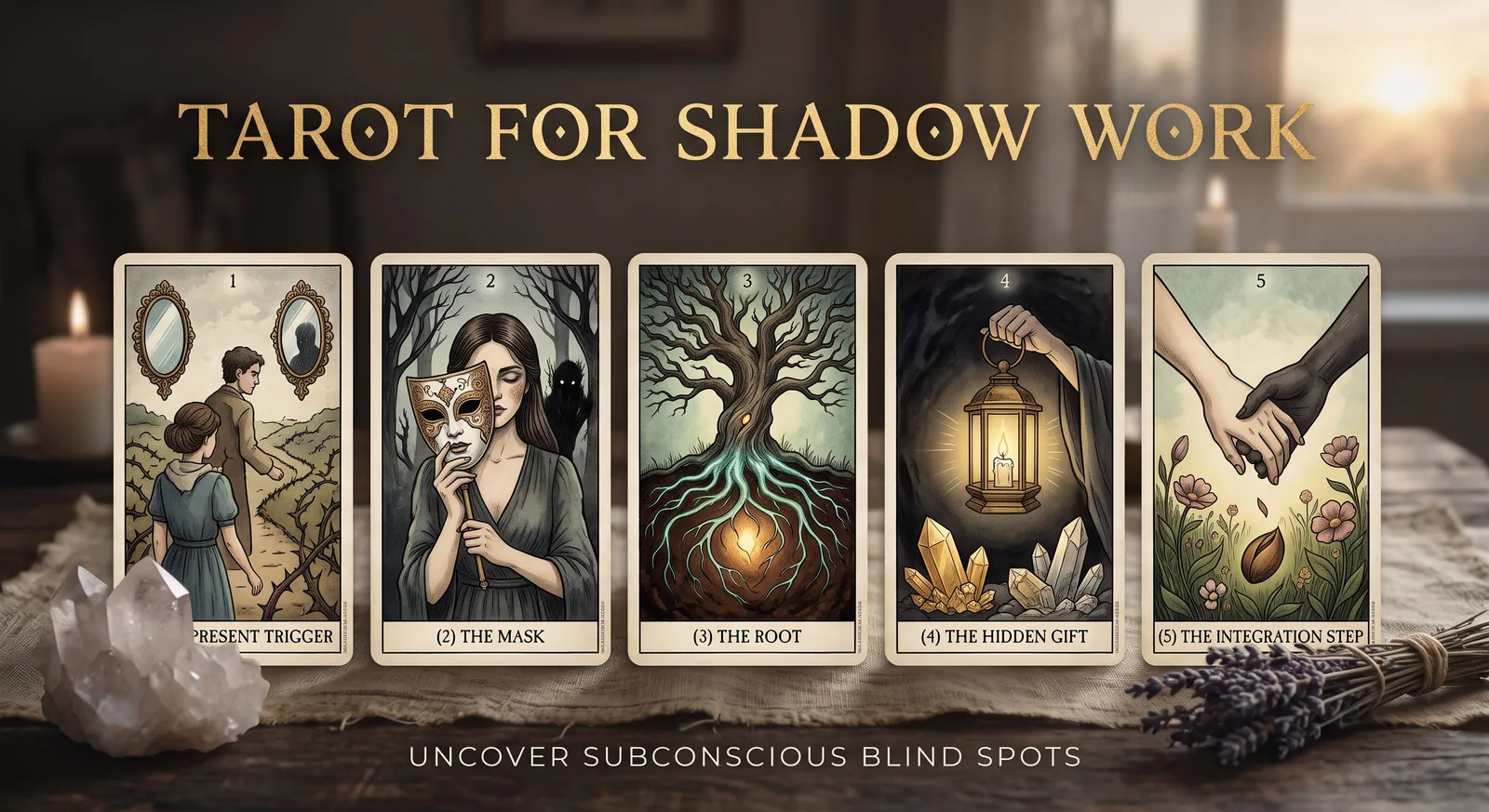
This five-card shadow work spread is designed to help you move from trigger → defense → root → strength → action.
What Is Shadow Work?
The idea of the "shadow" is closely associated with Swiss psychiatrist Carl Jung, who used the term to describe aspects of the personality that remain outside our conscious awareness.
The shadow isn't necessarily bad.
It can contain emotions we learned were unacceptable, traits we were discouraged from expressing, desires we didn't feel safe acknowledging, or even positive qualities we never learned to own.
For example, someone who prides themselves on being independent might have difficulty admitting that they need support.
Someone who always appears calm might suppress anger until it comes out indirectly.
Someone who is constantly helping others might struggle to receive help themselves.
Shadow work creates space to notice these contradictions without immediately judging them.
Where does tarot fit in?
Tarot doesn't need to be treated as a supernatural diagnostic tool.
For shadow work, you can use the cards as symbolic prompts for reflection.
A card gives you an image, archetype, story, or emotional theme. Your reaction to it becomes part of the reading.
Sometimes the most valuable question isn't "What does this card mean?"
It's:
"Why did I react so strongly when I saw it?"
That reaction may tell you something worth exploring.
The 5-Card Shadow Work Tarot Spread
Before you pull the cards, take a moment to identify something that's emotionally active in your life.
It could be:
- A recurring argument
- A relationship that keeps triggering you
- Jealousy
- Procrastination
- Fear of rejection
- Difficulty setting boundaries
- Feeling overlooked
- A pattern you're tired of repeating
- An emotion you don't understand
You don't need to choose your deepest wound.
Start with something that is present and workable.
Then shuffle while holding one simple intention:
Show me what I may not be seeing clearly about this pattern.
Lay five cards from left to right.

Card 1: The Present Trigger
What is challenging me right now?
The first card represents the situation or emotional pressure bringing the shadow to the surface.
This isn't necessarily the entire problem. It's the doorway into the problem.
Ask:
- What about this situation bothers me most?
- What emotion comes up immediately?
- Is my reaction proportional to what's happening?
- What does this situation seem to threaten?
- Does this feeling remind me of anything familiar?
For example, pulling the Five of Wands might point toward competition, conflict, or feeling that you have to fight to be heard.
But don't stop at the textbook meaning.
Ask yourself:
"Why does competition feel threatening to me?"
That's where the shadow work begins.
Card 2: The Mask
How am I projecting or defending?
The second card looks at the persona you use to protect yourself.
Everyone has masks.
The competent one.
The funny one.
The independent one.
The agreeable one.
The person who doesn't care.
The person who always has everything under control.
A mask isn't necessarily fake. It may have developed because it worked.
The question is whether you're still using it when you no longer need it.
Ask:
- What version of myself am I presenting?
- What am I trying to make other people believe?
- What emotion am I hiding?
- What would happen if I stopped defending myself this way?
- Am I projecting something onto another person?
A Queen of Swords, for example, could reflect healthy discernment and boundaries. But in a shadow-work reading, it might also invite you to examine whether emotional distance has become your primary form of protection.
The card isn't accusing you.
It's asking you to look.
Card 3: The Root
What underlying fear or past pattern is being activated?
This is usually the deepest card in the spread.
It asks what might be underneath the present reaction.
The root could be:
- Fear of abandonment
- Fear of failure
- Fear of being judged
- Fear of losing control
- Fear of being misunderstood
- Fear of not being enough
- Fear of needing someone
- Fear of being seen
It can also point toward an old behavioral pattern.
Perhaps you learned that being useful earned approval.
Perhaps you learned that vulnerability wasn't safe.
Perhaps you learned to stay quiet to avoid conflict.
You don't need to force a childhood explanation onto every tarot card.
Sometimes the root is much more recent.
The important question is:
"Where have I felt this before?"
If the same emotional pattern appears in different relationships, workplaces, or situations, that's often more useful information than trying to identify one perfect origin story.

Card 4: The Hidden Gift
What strength have I rejected, suppressed, or forgotten?
This is the card that keeps shadow work from becoming an exercise in self-criticism.
The shadow doesn't only contain difficult things.
It can also contain unused potential.
Maybe you've suppressed your ambition because you were afraid of seeming selfish.
Maybe you've rejected your anger even though anger could help you recognize when a boundary has been crossed.
Maybe you've made yourself smaller because being visible felt uncomfortable.
Maybe you've dismissed your intuition because you wanted to appear rational.
Ask:
- What quality am I not giving myself permission to express?
- What strength have I pushed away?
- What part of me wants more room?
- What would this quality look like in a healthy form?
- How could I reclaim it without letting it control me?
A King of Wands might suggest confidence, leadership, or creative authority.
The shadow version could be domination or ego.
The integration isn't to become "more King of Wands" at any cost.
It's to ask:
"How can I reclaim confidence without becoming controlling?"
That's the difference between shadow work and simply collecting tarot meanings.
Card 5: The Integration Step
What conscious action can I take now?
The final card brings the reading back to earth.
This is important.
Shadow work isn't complete when you've identified a pattern. Awareness is the beginning. Integration means choosing how you respond differently.
Your fifth card should become a practical experiment.
Ask:
- What can I do differently this week?
- What boundary needs to be communicated?
- What conversation am I avoiding?
- What emotion needs acknowledgment?
- What belief deserves to be questioned?
- What would responding consciously look like?
If you pull the Four of Swords, your integration might involve creating space before reacting.
If you pull the Strength card, it might mean responding with patience instead of suppressing anger.
If you pull the Eight of Cups, it might ask you to consider whether something you've outgrown still deserves your energy.
The goal isn't to obey the card.
The goal is to turn reflection into choice.
How to Read Difficult Tarot Cards During Shadow Work
Shadow work naturally brings you toward uncomfortable material, so difficult cards are not necessarily bad cards.
In fact, they can sometimes be the most illuminating.
Swords: What am I thinking myself into?
Swords often bring attention to thoughts, beliefs, communication, conflict, and mental patterns.
A difficult Sword card can be an invitation to examine the story you're telling yourself.
The Nine of Swords, for instance, doesn't have to mean something terrible is coming.
For shadow work, it could ask:
"What fear becomes louder when I'm alone with my thoughts?"
The Seven of Swords might prompt questions about avoidance, self-protection, or where you're not being completely honest with yourself.
Don't automatically interpret swords as punishment.
Look for the mental pattern underneath them.

The Tower: What structure can no longer hold?
The Tower can be one of the most frightening cards to receive.
But in a reflective reading, it doesn't have to predict disaster.
It can represent a belief, identity, expectation, or coping strategy that is becoming impossible to maintain.
Ask:
"What am I trying to keep standing even though I know it isn't working anymore?"
Sometimes the Tower is less about something falling apart and more about finally admitting that it already has.
That recognition can be painful.
It can also be liberating.
Reversed Cards: Look inward
Reversed cards don't have to mean "bad."
One useful approach during shadow work is to read a reversal as internalized, blocked, delayed, exaggerated, or unconscious energy.
For example, a reversed Empress could prompt reflection around receiving, self-worth, creativity, or nurturing yourself.
A reversed Chariot might raise questions about control, conflicting desires, or trying to force yourself forward when part of you wants to stop.
You don't need a complicated reversal system.
Ask:
"What happens when the energy of this card is turned inward?"
That question can open up an entirely different layer of the reading.
Don't Let the Cards Tell You Who You Are
One of the biggest mistakes in shadow work tarot is turning a symbolic reading into a fixed identity.
Pulling the Devil doesn't mean you're toxic.
Pulling the Five of Swords doesn't mean you're secretly a bad person.
Pulling the Tower doesn't mean disaster is coming.
A tarot card describes a theme to explore, not a permanent verdict about your character.
Try replacing statements like:
"I am the Devil."
with:
"Where might attachment, temptation, control, or avoidance be showing up in my life?"
That small change keeps the reading open.
You're exploring yourself, not sentencing yourself.
A Simple Shadow Work Tarot Journal Exercise
After completing the five-card spread, write down each card and answer three questions:
1. What was my immediate reaction to this card?
Don't censor it. If you hated the card, write that down.
2. What interpretation makes me uncomfortable?
This is often where the useful material lives.
3. What is one thing I can consciously do differently?
Keep this practical.
Instead of:
"I need to heal my abandonment wound."
try:
"When I feel ignored this week, I'll wait before assuming someone doesn't care about me."
The second statement gives you something you can actually practice.
Shadow Work Tarot Is About Curiosity, Not Self-Punishment
The purpose of shadow work isn't to uncover an endless list of flaws.
It's to become more whole.
The qualities we reject in ourselves don't necessarily disappear. Sometimes they simply find indirect ways to express themselves.
Anger might become resentment.
Need might become clinginess.
Ambition might become jealousy.
Fear might become control.
Vulnerability might become emotional distance.
When you can recognize these patterns without immediately judging yourself, you gain another option:
choice.
That's what makes tarot useful here.
The cards don't need to tell you what your future will be.
They can simply help you ask better questions about your present.
Your 5-Card Shadow Work Spread at a Glance
| Card | Position | Question |
|---|---|---|
| 1 | The Present Trigger | What is challenging me? |
| 2 | The Mask | How am I projecting or defending? |
| 3 | The Root | What fear or past pattern is underneath this? |
| 4 | The Hidden Gift | What strength have I suppressed or rejected? |
| 5 | The Integration Step | What conscious action can I take now? |
The sequence to remember:
Trigger → Mask → Root → Gift → Integration
That sequence takes you from what is happening to how you're responding, then deeper into why, before bringing the insight back into everyday life.
And that's ultimately what makes shadow work valuable.
Not discovering a darker version of yourself.
Discovering the parts of yourself that are ready to be seen.
Tarot birth card calculator
Find the Major Arcana cards linked to your birth date, using the method from our birth card guide.
Frequently asked questions
What is shadow work tarot?
What tarot spread is best for shadow work?
Can tarot reveal your subconscious?
What tarot cards represent the shadow self?
Should I use reversed cards for shadow work?
What should I do after a shadow work tarot reading?
Keep reading



Across Psychic Pulse
The same themes, seen through another practice.