Sleep Paralysis and Astral Projection: How to Navigate the Vibrational Stage Without Fear
Discover the mysterious space between waking and dreaming, where strange vibrations, altered awareness, and spiritual exploration meet.
In this article (9)
Discover the mysterious space between waking and dreaming, where strange vibrations, altered awareness, and spiritual exploration meet.
Imagine waking in the middle of the night.
Your eyes are open, but your body refuses to move. You feel an unusual vibration spreading through your chest, perhaps accompanied by a deep humming sound, rushing wind, or the sensation that something is moving around you.
You are aware of your surroundings, yet something feels different. It is as though you are standing at the edge of two worlds: one connected to your physical body and the other belonging to the mysterious landscape of dreams.
For some people, this experience is terrifying. For others, it becomes the beginning of a deeper spiritual curiosity.
Sleep paralysis has been described in spiritual traditions, folklore, and personal accounts for centuries. Some cultures associate it with nighttime visitors or supernatural encounters. Others interpret the experience as an opportunity to explore consciousness beyond ordinary waking awareness.
One particularly fascinating aspect is what many astral projection practitioners call the vibrational stage.
This is the moment when people report intense buzzing, tingling, humming, or waves of energy moving throughout their bodies while they remain unable to move physically.
Could this be a doorway into astral projection? Why do these sensations happen? And, most importantly, how can you navigate the experience without allowing fear to take control?
Let's explore the spiritual meaning of the vibrational stage, its connection to sleep paralysis, and the practices people use when exploring the boundary between waking and dreaming.
What Is the Vibrational Stage During Sleep Paralysis?
The vibrational stage is a term commonly used in astral projection communities to describe an unusual state of awareness in which a person experiences powerful internal sensations while transitioning between sleep and wakefulness.
These sensations can take many forms:
- Electrical vibrations: A feeling of energy moving through the body, sometimes described as thousands of tiny electrical pulses.
- Deep humming sounds: Hearing a low-frequency buzzing, rushing wind, or mechanical-like vibration without an obvious external source.
- Waves of movement: Feeling as though the body is rocking, spinning, shaking, or gently floating.
- Weightlessness: Experiencing a sensation of becoming lighter, as though gravity has temporarily disappeared.
- A presence in the room: Feeling that someone or something is nearby, even when no one is physically present.
Not everyone experiences these sensations, and they can vary considerably from one episode to another.
From a sleep-science perspective, sleep paralysis occurs when awareness returns while the temporary muscle immobility associated with REM sleep continues. Dreamlike sensations can overlap with awareness of the surrounding room.
In spiritual circles, however, the vibrational stage is often interpreted differently.
Some practitioners believe it represents a transition in consciousness, where awareness becomes less connected to ordinary physical sensations. Within astral projection traditions, this is sometimes described as the moment before an out-of-body experience.
Whether you understand it as an unusual sleep phenomenon or a spiritual threshold, the experience can feel remarkably vivid.
The most important thing to remember is that unusual sensations do not automatically mean something is wrong.
Why Does Sleep Paralysis Feel Like an Energetic Experience?
One of the most fascinating aspects of sleep paralysis is how physical and emotionally powerful it can feel.
You may sense movement without moving. You may hear sounds that seem to come from somewhere beyond the room. You may feel a wave of energy traveling through your chest, arms, or legs.
There is a reason these experiences can feel so real.
During REM sleep, the brain temporarily prevents most voluntary muscles from acting out dreams. Sometimes, awareness returns before this temporary muscle inhibition has ended.
The result is a strange overlap: your mind becomes aware, but your body remains in its sleep-related state.
Dreamlike imagery and sensations can also continue during this transition.
From a spiritual perspective, some people use the language of energy, vibration, and consciousness to describe what they experience.
The two interpretations do not need to be confused with one another. Sleep science can help explain the physical experience, while spiritual traditions offer symbolic ways of exploring its personal meaning.
Perhaps the most useful approach is to remain curious without feeling pressured to decide exactly what is happening.
The Connection Between Vibrations and Astral Projection
Astral projection is a spiritual practice based on the belief that consciousness or a subtle energetic body can experience separation from the physical body.
People who practice astral projection often describe a sequence of experiences:
- Deep relaxation as the body begins to fall asleep.
- Awareness remaining present while physical sensations become distant.
- Vibrations, buzzing, humming, or sensations of movement.
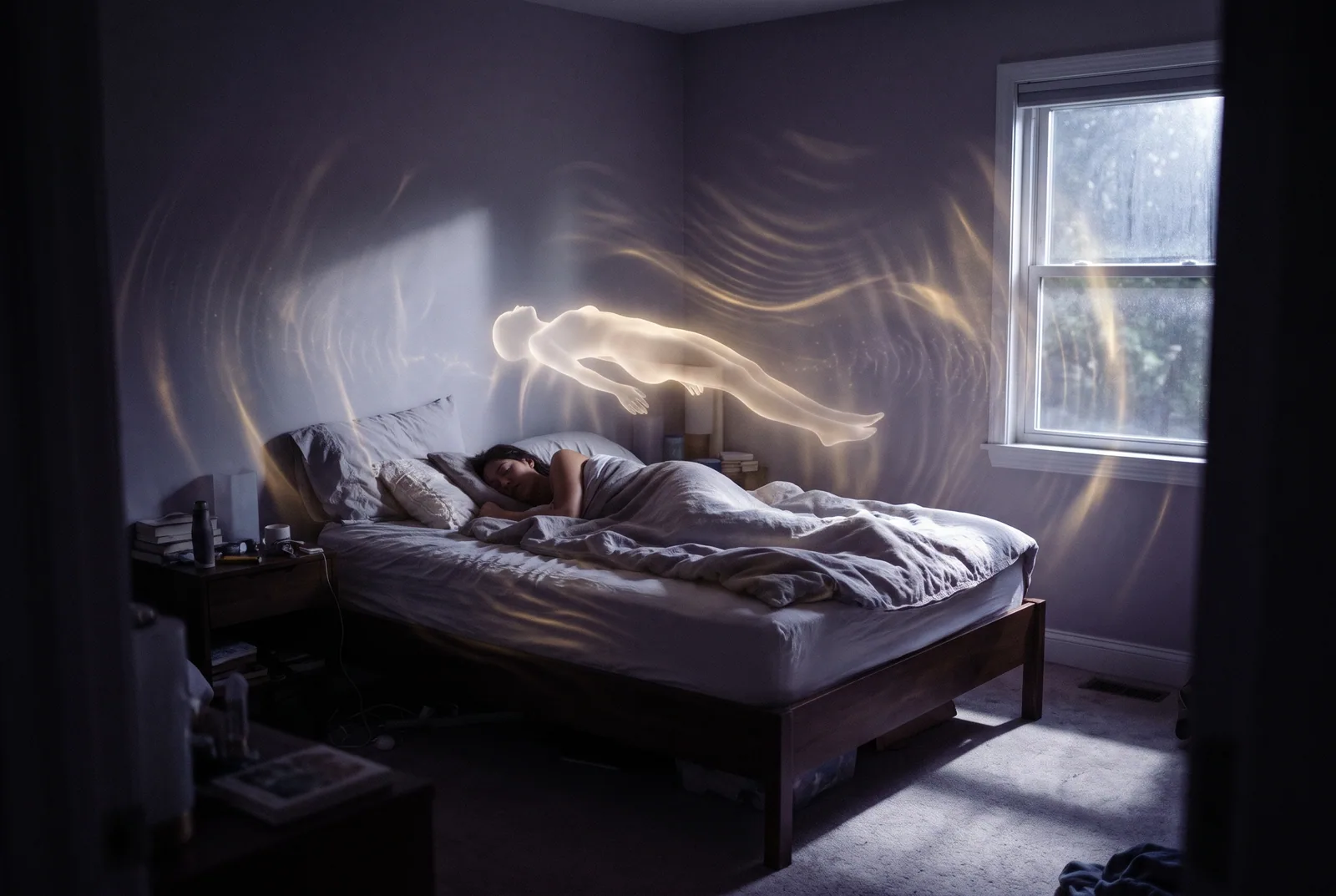
- A feeling of floating, rolling, or rising above the bed.
- An experience interpreted as traveling beyond the physical body.
This sequence is frequently discussed in out-of-body experience communities.
However, it is important to understand that subjective out-of-body experiences have not established that consciousness literally leaves the physical body.
You can still explore the experience as a meaningful spiritual or dream practice without needing to treat one interpretation as proven fact.
For many people, the deeper attraction is the opportunity to explore awareness, imagination, dreams, and the mysterious nature of consciousness.
Why Do You See Shadows or Feel a Presence During Sleep Paralysis?

Perhaps the most frightening part of sleep paralysis is the feeling that you are not alone.
Some people describe seeing dark figures standing near their beds. Others report footsteps, whispers, unfamiliar faces, or an invisible presence pressing against their chest.
These experiences can feel incredibly convincing.
Throughout history, different cultures have given them different names. In European folklore, they were sometimes associated with the night hag. Other traditions interpreted them as spirits, visitors, or supernatural beings.
Modern sleep science offers another explanation.
When dream imagery overlaps with awareness of the bedroom, the mind can generate vivid hallucinations. Fear can intensify these perceptions, making an imagined presence feel extraordinarily real.
This does not mean that your experience is unimportant or that you should dismiss how frightening it felt.
It simply means that seeing a figure during sleep paralysis is not evidence that something supernatural has entered your room.
How Fear Changes the Experience
Fear can become part of a powerful emotional cycle.
You wake up unable to move. Your mind recognizes that something unusual is happening. Your body responds with alarm, and the dreamlike state may produce frightening images or sensations.
The more frightened you become, the more threatening the experience can feel.
This is why changing your relationship with sleep paralysis can make such a difference.
Instead of immediately assuming danger, try gently reminding yourself:
I am experiencing a temporary sleep state. My body is resting, and this feeling will pass.
You do not have to fight the experience.
You do not have to interpret every sound or sensation.
Sometimes, the most powerful thing you can do is allow yourself to become calm.
How to Explore the Vibrational Stage Without Fear
For people interested in astral projection, the vibrational stage is often considered an important part of the experience.
Rather than forcing anything to happen, the emphasis is on relaxation, patience, and maintaining a calm awareness.
The following practices are commonly discussed in astral projection communities. They can also be approached as imaginative visualization exercises during the transition into sleep.
1. The Lateral Roll-Out Technique
The roll-out technique is one of the best-known methods described by astral projection practitioners.
The idea is to imagine yourself gently rolling sideways without physically moving your sleeping body.
Here is how to explore the visualization:
Step 1: Allow Yourself to Relax
If you notice buzzing, tingling, or unusual sensations, avoid immediately reacting to them.
Allow your breathing to remain natural. Relax your face, shoulders, and jaw.
There is no need to force the vibrations to become stronger.
Step 2: Imagine Rolling Sideways
Picture yourself slowly rolling toward the edge of the bed.
Try to imagine the movement from the perspective of your awareness rather than physically contracting your muscles.
Step 3: Follow the Sensation
Some practitioners describe a feeling of falling, turning, or gently shifting.
If you experience something similar, remain calm and observe it without trying to control every detail.
You may experience a vivid dreamlike transition, or nothing unusual may happen at all.
Both outcomes are normal.
2. The Floating or Rising Technique

Another popular visualization involves imagining yourself becoming weightless.
Rather than focusing on movement across the bed, this practice uses the feeling of gentle upward motion.
Step 1: Focus on Your Inner Awareness
Bring your attention to the sensations around your chest, shoulders, and head.
If you notice warmth, tingling, or a gentle humming sensation, simply observe it.
Step 2: Imagine Weightlessness
Picture yourself becoming lighter with every breath.
Imagine that your body is resting comfortably while your awareness feels as light as a feather.
Step 3: Visualize Rising
Imagine slowly drifting toward the ceiling, surrounded by a peaceful, protective light.
Do not strain or hold your breath. Let the visualization remain gentle.
For some people, this may lead into a vivid dream or lucid dreaming experience. Others may simply become more relaxed and fall asleep.
The value of the practice is not measured by whether an out-of-body experience occurs.
It is about developing a calmer relationship with the space between waking and dreaming.
How to Stop Sleep Paralysis If You Become Frightened
Spiritual exploration should never come at the expense of your sense of safety.
If the experience becomes overwhelming, you do not need to continue exploring it.
Sleep paralysis is temporary. Although it can feel frightening, it does not mean that you are trapped.
You can try several simple grounding techniques to help yourself return to full wakefulness.
Focus on a Small Movement
Instead of trying to move your entire body, concentrate on a very small movement.
You might try:
- Gently moving one finger.
- Attempting to wiggle a toe.
- Swallowing.
- Making a small movement with your tongue or facial muscles.
These movements may help you reconnect with your physical body, although they do not guarantee an immediate end to the episode.
Return Your Attention to Your Breathing
Breathing continues automatically during ordinary sleep paralysis.
Rather than fighting the sensation, gently notice the natural rhythm of your breath.
You can silently repeat:
I am safe. My body is resting. This experience is temporary.
The intention is to calm your nervous system rather than force your way out of the experience.
Open Your Awareness to the Room
If your eyes are open, try focusing on one familiar object.
It could be a bedside table, a window, or a familiar shape in the room.
Remind yourself where you are and that you are experiencing a temporary sleep-related state.
If the episode ends, take a moment to become fully awake before returning to sleep.
When to Seek Medical Advice
Occasional sleep paralysis is generally not dangerous. However, if episodes happen frequently, cause significant distress, interfere with your sleep, or are accompanied by severe daytime sleepiness, consult a healthcare professional or sleep specialist.
Sleep paralysis can sometimes occur alongside other sleep conditions, and it is worth investigating persistent symptoms.
If you feel overwhelmed, you always have permission to choose rest over exploration.
The Spiritual Meaning of the Space Between Sleep and Waking
Why do so many people find the vibrational stage spiritually fascinating?
Perhaps it is because the experience challenges the way we normally understand awareness.
During ordinary waking life, we tend to identify ourselves with our physical bodies. We move, see, hear, and experience the world through familiar senses.
But during sleep paralysis, those familiar boundaries can feel different.
You may experience movement without physical movement, hear sounds without an identifiable source, or feel that your awareness is somewhere other than where your body rests.
Spiritual traditions often explore these moments as opportunities for introspection.
Rather than viewing the experience as something to fear, you might use it as an invitation to explore three deeper questions.
What is awareness when the body is still?
The experience can encourage reflection on the relationship between physical sensation, dreams, and consciousness.
Why does fear appear when familiar boundaries disappear?
Sleep paralysis can reveal how strongly our minds respond to uncertainty and unfamiliar experiences.
Can I learn to remain calm when I cannot control everything?
Perhaps the most meaningful lesson is learning to surrender the need to control every sensation.
You do not have to believe in astral projection to find personal meaning in these questions.
Sometimes, the spiritual value of an experience comes from what it teaches us about ourselves.
Is the Vibrational Stage a Sign of Spiritual Awakening?
Some people interpret unusual sleep experiences as signs of spiritual awakening.
They may associate vibrations, heightened awareness, vivid dreams, and altered sensations with an expansion of consciousness.
In certain spiritual communities, these experiences are connected to energy work, meditation, kundalini traditions, or astral exploration.
However, experiencing sleep paralysis does not necessarily mean that you are undergoing a spiritual awakening.
It is not a test of spiritual development, and there is no need to pursue increasingly intense experiences to prove that you are becoming more spiritually aware.
If the experience inspires you to meditate, reflect, journal, or become more conscious of your inner world, that personal meaning can be valuable.
Let curiosity guide you, not fear or pressure.
How to Integrate Your Experience After Sleep Paralysis
Whether you experienced a frightening episode, a peaceful floating sensation, or something that felt like an out-of-body journey, taking time to reflect can help you understand it.
Here are three simple practices.
- Write Down What Happened
Record what you remember as soon as you feel comfortable.
Were there vibrations? Did you hear sounds? Did you feel movement? Were you frightened or peaceful?
Writing down your experience can help you recognize patterns and understand how your feelings influence your interpretation.
- Reflect Without Forcing an Explanation
You do not need to decide whether an experience was neurological, psychological, spiritual, or a combination of different interpretations.
Allow yourself to remain curious.
Personal meaning does not require absolute certainty.
- Prioritize Rest and Grounding
Good sleep habits, a regular sleep schedule, and a calming bedtime routine may help reduce the likelihood of sleep paralysis.
If the experience leaves you unsettled, spend some time grounding yourself through gentle movement, meditation, or a familiar daily routine.
Spiritual exploration should bring greater understanding and peace, not constant anxiety.
Final Thoughts: Meeting the Unknown Without Fear
The vibrational stage is one of the most fascinating experiences described by people exploring sleep paralysis and astral projection.
For some, it is an unsettling encounter with the strange boundaries of sleep. For others, it becomes an invitation to explore lucid dreaming, consciousness, and spiritual traditions surrounding out-of-body experiences.
There is still much we do not fully understand about the richness of human consciousness.
But one thing is worth remembering: you do not need to fear every unfamiliar sensation.
You can remain curious without surrendering your sense of safety. You can explore spiritual ideas without treating every experience as supernatural proof. And you can choose to wake up whenever the experience becomes uncomfortable.
Perhaps the deeper lesson of the vibrational stage is not about leaving the physical body.
Perhaps it is about discovering how to remain peaceful when the familiar world becomes unfamiliar.
May you approach the mysteries of the night with an open heart, a grounded spirit, and the wisdom to know that curiosity and peace can exist together.
Frequently asked questions
What is the vibrational stage in sleep paralysis?
Is sleep paralysis connected to astral projection?
Why do I feel vibrations throughout my body during sleep paralysis?
Can sleep paralysis be a spiritual experience?
How can I enter the vibrational stage intentionally?
How do I stop being afraid of sleep paralysis?
Can you get stuck in sleep paralysis or an out-of-body experience?
What is the difference between lucid dreaming and astral projection?
Are vibrations during meditation the same as the vibrational stage?
Keep reading


Across Psychic Pulse
The same themes, seen through another practice.