Sleep Paralysis and Hypnagogia: The Spiritual Threshold Between Waking and Dreaming
Explore sleep paralysis and hypnagogia as liminal states between waking and dreaming. Discover why these experiences feel so vivid and how to meet them with calm, awareness, and spiritual curiosity.
In this article (10)
What happens when consciousness awakens before the body, and how you can meet the experience without fear
There is a strange place between sleeping and waking where the ordinary rules of consciousness seem to soften.
The room may look familiar, yet somehow different.
You may hear a sound that isn't really there. Feel a presence nearby. See a shadow at the edge of your vision. Sense yourself floating, falling, leaving your body, or simply feel that someone or something is in the room with you.
And sometimes, you realize you are awake but cannot move.
This is where sleep paralysis and hypnagogia meet.
From a scientific perspective, these experiences have understandable explanations involving the transition between sleep and wakefulness and the temporary muscle paralysis that naturally occurs during REM sleep.
But there is another way to approach them.
Rather than seeing these moments only as something frightening or abnormal, many spiritual and contemplative traditions have regarded the border between waking and dreaming as a liminal space, a threshold where the conscious mind becomes quieter and the deeper imagination begins to speak.
That doesn't mean every shadow is a spirit or every sensation carries a supernatural message.
It means that the experience can become an invitation:
Can you remain present when reality feels unfamiliar?
Can you breathe through fear?
Can you witness the images of your dreaming mind without immediately believing them?
And can you discover what becomes possible when you stop fighting the threshold?
What Is Hypnagogia?
Hypnagogia is the transitional state between wakefulness and sleep.
It is the moment when the conscious mind begins to loosen its grip on ordinary reality.
You might experience:
- flashes of light or color
- geometric patterns
- sounds, voices, music, or buzzing
- sensations of falling or floating
- sudden images or faces
- the feeling that someone is nearby
- unusual bodily sensations
- brief dream scenes
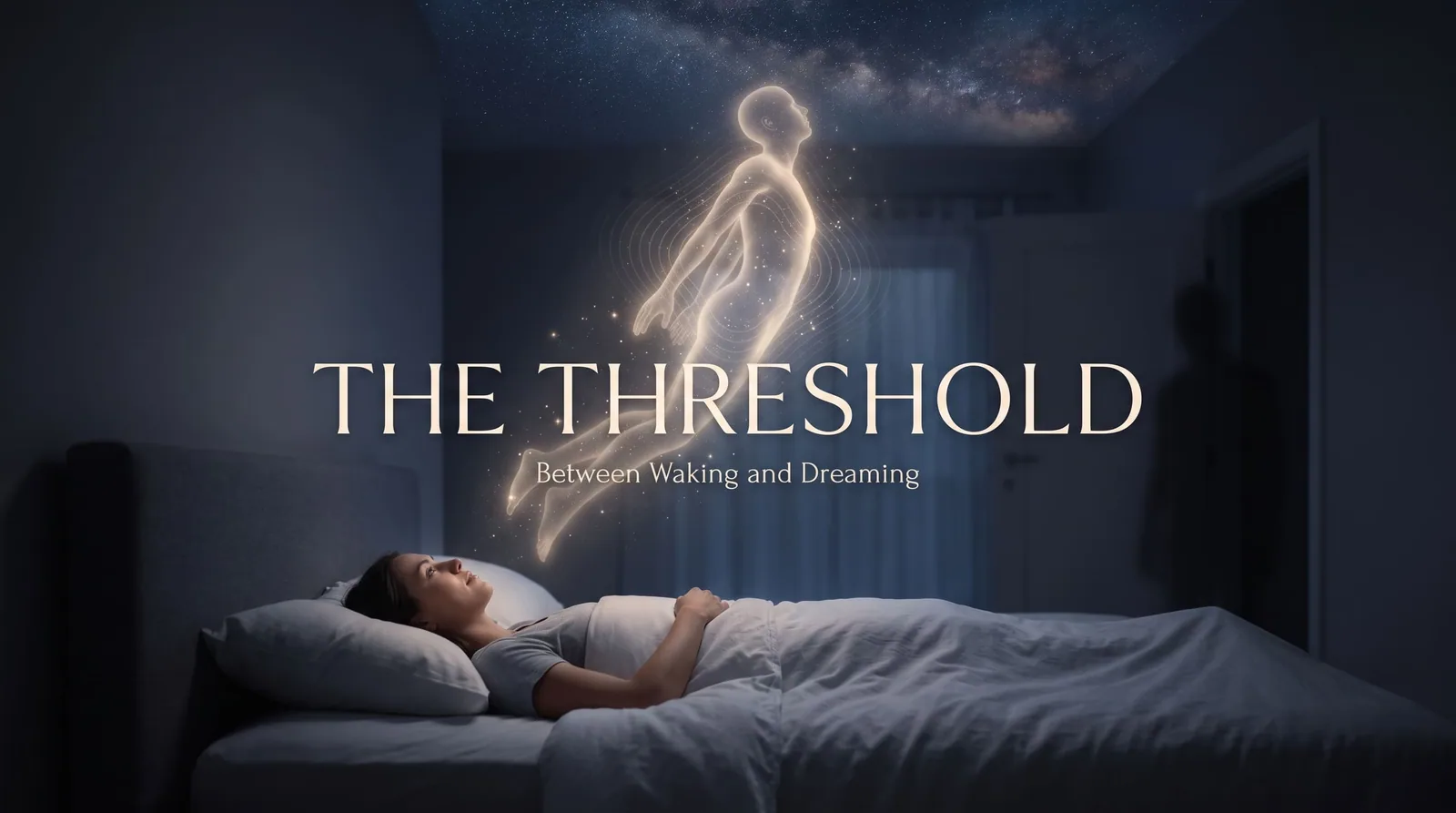
- a feeling of leaving or moving outside your body
These experiences are often called hypnagogic hallucinations, although the word “hallucination” can make them sound more pathological than they usually are.
A gentler way to understand them is as dream imagery appearing while you are still partly aware.
Your body is moving toward sleep, while a small part of your observing awareness remains awake.
This is one reason hypnagogia has fascinated mystics, meditators, artists, lucid dreamers, and spiritual practitioners for centuries.
It is a doorway.
Not necessarily a doorway to another dimension, but a doorway into the mysterious landscape of your own consciousness.
What Is Sleep Paralysis?
Sleep paralysis occurs when your awareness becomes awake while your body remains temporarily in the muscle-inhibited state associated with REM sleep.
In ordinary sleep, this temporary paralysis is protective. It prevents you from physically acting out your dreams.
Occasionally, the timing becomes slightly out of sync.
Your mind wakes up.
Your body hasn't quite caught up.
The result can be deeply unsettling.
You may be unable to move your arms or legs. Your chest may feel heavy. Breathing can feel strange. You might sense another presence in the room or see dream imagery projected onto your surroundings.
The experience can last seconds or several minutes, although it may feel much longer.
Most importantly:
The experience is real, but the frightening imagery does not necessarily represent an external threat.
Your brain is still partially immersed in the dream state.
And that distinction can transform the experience.
Why Does Sleep Paralysis Feel So Spiritual?
This is where the experience becomes particularly fascinating.
Sleep paralysis sits directly between two states of consciousness.
You are not completely asleep.
You are not completely awake.
Your physical environment is present, but dream imagery can appear inside it.
Your rational mind may recognize your bedroom while another part of your consciousness is creating symbols, sensations, sounds, and narratives.
That combination can feel profoundly mystical.
Across cultures, people have interpreted these experiences in different ways. Some have described spirits, ancestors, demons, visitors, energetic beings, astral experiences, or encounters with another realm.
There is no scientific evidence that sleep paralysis itself proves such supernatural interpretations.
But spiritual symbolism can still provide a meaningful framework for reflection.
Instead of asking only:
“What was that?”
you might also ask:
“What did this experience awaken in me?”
That question brings the experience back into your own consciousness.
The Shadow Figure: What Does It Mean?
One of the most common features of sleep paralysis is the sensation that another presence is nearby.
Sometimes this becomes a recognizable figure.
A person standing in the doorway.
A dark silhouette.
A face.
A shape beside the bed.
A presence sitting on the chest.
Because the brain's threat-detection systems can remain highly active during this unusual state, fear can quickly shape ambiguous sensations into a story.
The more frightened you become, the more threatening the experience can feel.
From a spiritual perspective, however, you can work with the image symbolically without deciding that it is literally an external being.
Ask yourself:
What does the shadow represent to me?
Perhaps it represents fear.
Perhaps the unknown.
Perhaps something you have been avoiding.
Perhaps simply the mysterious nature of dreaming itself.
You don't have to fight it.
You don't have to worship it.
And you don't have to believe it is literally real.
You can simply observe.
“I am experiencing a shadow.”
That small shift—from this is happening to me to I am witnessing this experience—can create an extraordinary amount of inner space.
The Spiritual Lesson of Sleep Paralysis
If there is one lesson hidden inside the experience, it may be this:
You don't have to believe everything you perceive.
During sleep paralysis, your senses can produce experiences that feel completely convincing.
Yet you may eventually wake fully and realize that the presence wasn't physically there.
This makes sleep paralysis a powerful reminder of something that applies far beyond sleep:
Perception is not always the same as reality.
Fear can create convincing stories.
The mind can turn uncertainty into certainty.
And sometimes the most powerful spiritual practice is simply learning to witness an experience without immediately attaching meaning to it.
How to Stay Calm During Sleep Paralysis
If sleep paralysis happens to you, your first instinct may be to fight.
You try to force your arms to move.
You struggle to sit up.
You attempt to escape the sensation.
But fighting the experience can increase panic.
Instead, experiment with surrender.
1. Remember what is happening
If you recognize the experience, remind yourself:
“My mind is awake. My body is still sleeping. This will pass.”
That simple thought can interrupt the fear response.
2. Return to your breath
You do not need to take enormous breaths.
Simply notice the breath that is already happening.
Feel the inhale.
Feel the exhale.
Let your attention rest there.
Your breath becomes an anchor between the dreaming world and the physical world.
3. Stop fighting the body
Rather than demanding that your entire body move, allow it to remain still.
Imagine yourself becoming heavier.
Softer.
More surrendered.
Paradoxically, releasing resistance can make the experience feel much less frightening.
4. Focus on one tiny movement
If you want to wake fully, try concentrating on something small—a finger, toe, tongue, or gentle facial movement.
Don't strain.
Just imagine movement.
Sometimes that tiny point of physical awareness helps the rest of the body reconnect.
5. Let the imagery pass
If you see something, you don't have to engage with it.
Watch it.
Let it change.
Let it disappear.
Dream imagery has a naturally changing quality.
You can become the witness rather than the participant.
Can Sleep Paralysis Become a Lucid Dream?
For some people, yes.
The space between waking and dreaming can become a doorway into lucid dreaming—a dream in which you become aware that you are dreaming.
Rather than trying to escape sleep paralysis immediately, experienced lucid dreamers sometimes use the transition as an opportunity to enter the dream consciously.
You might imagine:
- floating upward
- gently rolling out of bed
- walking through a doorway
- entering a peaceful landscape
- allowing yourself to drift into darkness
- following a sound or light into a dream
The key is not force.
It is awareness.
You are allowing the dreaming mind to unfold while maintaining a thread of conscious observation.
For some people, this becomes one of the most fascinating aspects of hypnagogia: the possibility of witnessing the moment when an ordinary thought becomes an entire dream world.
Is Sleep Paralysis a Spiritual Awakening?
Not necessarily.
Experiencing sleep paralysis does not automatically mean you are spiritually awakening, developing psychic abilities, encountering spirits, or receiving a supernatural message.
But the experience can become spiritually meaningful if you choose to explore it.
Liminal experiences often make us question our assumptions about consciousness.
They remind us that our ordinary waking reality is only one state of awareness among many.
You may come away from sleep paralysis with a deeper curiosity about dreams, meditation, consciousness, intuition, or the mysterious relationship between mind and body.
That curiosity can be valuable without requiring a supernatural explanation.
A Simple Ritual for the Sleep-Waking Threshold
If you frequently experience vivid hypnagogic states, you can create a gentle ritual around sleep.
Before going to bed, dim the lights and put your phone away.
Take several slow breaths.
Place one hand over your heart and one over your abdomen.
Then quietly say:
“I am safe in my body. I allow myself to rest. Whatever arises, I can witness without fear.”
You can then set an intention:
“Tonight, I remember my dreams.”
Or:
“Tonight, I meet the unknown with curiosity.”
You don't need elaborate rituals.
The purpose is simply to teach your nervous system that the transition into sleep is a place of safety rather than anticipation.
When the Threshold Becomes a Teacher
The most transformative way to approach sleep paralysis may be neither to dismiss it nor to become consumed by it.
You can hold both perspectives.
The body has a biological explanation.
The experience can still carry personal meaning.
Those ideas don't have to compete.
Perhaps the shadow was a product of your dreaming brain.
Perhaps the experience revealed something about your relationship with fear.
Perhaps it simply showed you how strange and beautiful consciousness can be.
You don't have to decide immediately.
The threshold itself can remain mysterious.
And perhaps that is part of its gift.
Because sometimes spiritual growth isn't about finding an immediate explanation.
Sometimes it is about becoming comfortable standing at the edge of what you don't yet understand.
A Final Invitation to the Threshold
Sleep paralysis can be terrifying.
But once you understand what is happening, fear doesn't have to be the only story you tell about it.
You can meet the experience with curiosity.
You can breathe.
You can observe.
You can remind yourself that the body knows how to return to wakefulness.
And if you choose, you can explore the experience as a doorway into the deeper mysteries of dreaming and consciousness.
The next time you find yourself suspended between sleep and waking, remember:
You are standing at a threshold.
You don't have to understand everything you encounter there.
You only have to remember that you can witness it without fear.
Frequently asked questions
What is the difference between sleep paralysis and hypnagogia?
Are hypnagogic hallucinations normal?
What is the spiritual meaning of sleep paralysis?
Why do I see a shadow figure during sleep paralysis?
Is sleep paralysis dangerous?
How can I stop sleep paralysis?
Can sleep paralysis lead to lucid dreaming?
What should I do if sleep paralysis keeps happening?
Keep reading


Across Psychic Pulse
The same themes, seen through another practice.